


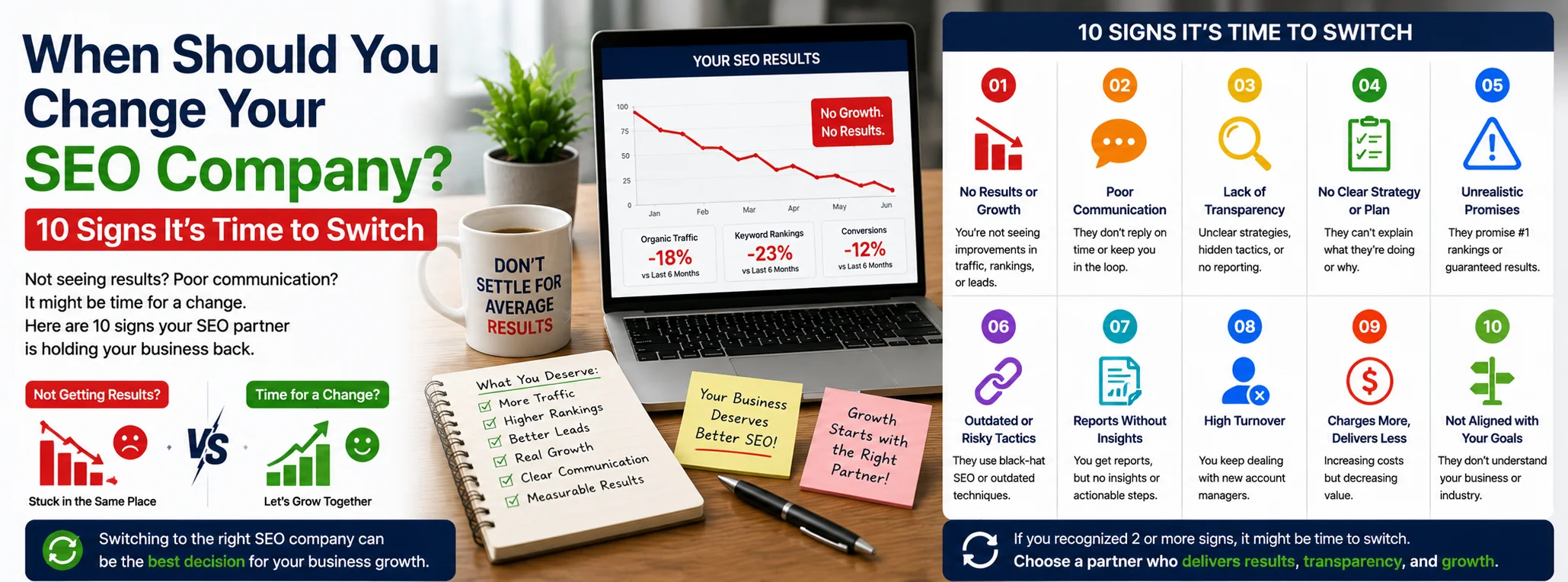
When Should You Change Your SEO Company? 10 Signs It’s Time to Switch
Hiring an SEO company is a long-term investment, so changing agencies is not a decision most businesses make lightly. However, if your SEO campaign is not delivering meaningful progress, communication is poor, reporting is unclear, or the strategy no longer matches your business goals, it may be time to reconsider your SEO partner.
Knowing when to change your SEO company can help you avoid wasting time and budget on a strategy that is not producing the results your business needs.
Before making a decision, it is important to understand how to measure SEO agency performance and determine whether the problem is with the strategy, implementation, expectations, or communication.
If you are considering a new agency, our guide on how to compare SEO agencies can also help you evaluate potential SEO partners more effectively.
Table of Contents
- When Should You Change Your SEO Company?
- 10 Signs It’s Time to Change Your SEO Company
- 1. Your SEO Company Guarantees Google Rankings
- 2. You Are Not Seeing Meaningful Progress
- 3. Your SEO Strategy Is Unclear
- 4. Communication Is Poor
- 5. SEO Reporting Is Unclear or Incomplete
- 6. There Are No Clear SEO KPIs
- 7. Your SEO Strategy Uses Outdated Techniques
- 8. Your Agency Uses Low-Quality Link Building
- 9. SEO Is Not Connected to Business Goals
- 10. Your SEO Strategy Has Become Generic
- Other Warning Signs to Consider
- What to Do Before Changing Your SEO Company
- How to Change SEO Companies Without Losing Progress
- What to Look for in Your Next SEO Company
- SEO Company Switching Checklist
- Frequently Asked Questions
When Should You Change Your SEO Company?
You should consider changing your SEO company when there are persistent problems that your current agency is unable or unwilling to address.
One disappointing month does not necessarily mean you need a new agency. SEO performance can fluctuate because of competition, search algorithm changes, website changes, seasonality, and other factors.
However, consistent issues such as poor communication, unclear reporting, outdated SEO practices, lack of transparency, or no measurable progress can be signs that your current SEO partnership needs to change.
The first step is to identify the problem and allow the agency to explain and address it. If the same problems continue despite reasonable communication and time to improve, switching SEO companies may be appropriate.
10 Signs It’s Time to Change Your SEO Company
Every business situation is different, but the following warning signs deserve attention when evaluating your current SEO agency.
1. Your SEO Company Guarantees Google Rankings
No legitimate SEO company can control Google’s organic search results and guarantee a specific ranking position for competitive keywords.
If your agency promises guaranteed number-one rankings, instant results, or specific ranking positions without explaining the limitations of SEO, you should carefully evaluate its approach.
A professional SEO strategy should focus on improving your website’s relevance, technical health, content quality, authority, user experience, and overall organic visibility.
2. You Are Not Seeing Meaningful Progress
SEO can take time, and results vary by industry, competition, website condition, and strategy. A lack of immediate rankings does not automatically mean your agency is failing.
However, if your campaign has been running for an appropriate period and there is consistently no meaningful improvement in areas such as organic visibility, qualified traffic, conversions, or other agreed KPIs, you should ask why.
Ask your SEO company:
- What has been completed?
- What improvements have been made?
- What SEO issues remain?
- What has changed in the strategy?
- Which KPIs are improving?
- What are the next priorities?
If the agency cannot provide clear answers, it may be time to reconsider the relationship.
3. Your SEO Strategy Is Unclear
You should understand the basic direction of your SEO campaign even if you are not an SEO expert.
A good agency should be able to explain the following:
- What it is trying to achieve
- Which audiences it is targeting
- Which keywords and topics matter
- What technical issues need attention
- What content will be created or optimized
- How authority will be developed
- How progress will be measured
If your agency repeatedly gives vague explanations such as “we are working on SEO” without showing the strategy or priorities, that lack of transparency is a concern.
4. Communication Is Poor
SEO requires collaboration between the agency and the business. Poor communication can prevent important recommendations from being implemented and make it difficult to understand campaign progress.
Warning signs include:
- Slow or inconsistent responses
- Missed meetings
- No dedicated contact
- Unclear responsibilities
- Difficulty getting answers
- Little explanation of important SEO decisions
A strong SEO partner should make communication expectations clear from the beginning.
5. SEO Reporting Is Unclear or Incomplete
SEO reports should help you understand what happened, what changed, what was completed, and what the agency plans to do next.
Be cautious if your monthly report contains only a long list of keywords without explaining the broader business impact.
A useful SEO report may include:
- Organic traffic trends
- Organic conversions
- Qualified leads
- Important keyword visibility
- Search impressions
- Click-through rates
- Technical SEO improvements
- Content performance
- Completed work
- Next-month priorities
For more information, see our guide on how to measure SEO agency performance and SEO ROI.
6. There Are No Clear SEO KPIs
SEO should have measurable objectives. The right KPIs depend on your business goals, but they may include organic traffic, qualified leads, conversions, revenue, visibility, or other meaningful outcomes.
If your agency focuses exclusively on ranking positions without connecting SEO performance to your actual business goals, the strategy may need to be reconsidered.
Before changing agencies, make sure you have agreed on realistic SEO KPIs and a reasonable measurement period.
7. Your SEO Strategy Uses Outdated Techniques
Search engines and SEO best practices continue to evolve. A strategy that relies heavily on manipulative or outdated tactics can create unnecessary risk.
Be cautious of approaches such as the following:
- Keyword stuffing
- Automatically generated low-quality pages
- Large volumes of irrelevant backlinks
- Duplicate content at scale
- Manipulative link schemes
- Content created solely to target keywords without user value
Your SEO partner should prioritize useful content, technical quality, relevant authority, strong site structure, and a positive user experience.
8. Your Agency Uses Low-Quality Link Building
Backlinks can contribute to SEO, but quality and relevance matter more than simply accumulating a large number of links.
Ask your agency:
- Where are the links coming from?
- Why are those websites relevant?
- How are link opportunities identified?
- What quality standards are used?
- Are the methods transparent?
If an agency cannot explain its link-building approach or focuses primarily on quantity, you should investigate further.
9. SEO Is Not Connected to Business Goals
SEO should support a broader business objective.
For a lead-generation company, this may mean increasing qualified inquiries. For an e-commerce business, it may involve increasing organic revenue and product visibility. For a local business, it may involve generating more relevant local leads.
If your SEO agency talks only about rankings and traffic without understanding how your website generates business, the strategy may not be aligned with your needs.
10. Your SEO Strategy Has Become Generic
Your SEO strategy should evolve as your website, competitors, market, and search behavior change.
A warning sign is when the agency repeatedly performs the same basic tasks every month without reviewing performance or identifying new opportunities.
A strong SEO campaign should continually evaluate:
- Competitor activity
- Search intent
- New keyword opportunities
- Content gaps
- Technical issues
- Internal linking opportunities
- Conversion opportunities
- Changes in search behavior
Other Warning Signs to Consider
In addition to the major warning signs above, consider changing your SEO company if you experience:
- Unexpected or unexplained fees
- Unclear monthly deliverables
- Repeated missed deadlines
- Lack of ownership of SEO work
- No access to important SEO data
- Refusal to explain methods
- Pressure to extend the contract without evidence of progress
- Recommendations that do not match your business goals
What to Do Before Changing Your SEO Company
Before ending your relationship with an SEO company, review the situation objectively.
Ask yourself:
- Have the agreed deliverables been completed?
- Were the original goals realistic?
- Has the agency communicated clearly?
- Have SEO improvements been implemented?
- Are there measurable positive trends?
- Has the agency explained setbacks?
- Have you provided the access and resources needed?
Sometimes an SEO campaign is underperforming because important website changes were delayed or because the business did not provide the required resources. Make sure you understand the complete situation before making a final decision.
How to Change SEO Companies Without Losing Progress
If you decide to switch agencies, plan the transition carefully.
1. Collect Your SEO Data
Make sure you have access to important analytics, search performance data, keyword tracking, SEO audits, content records, and other relevant campaign information.
2. Review Existing SEO Work
Understand what has already been implemented so your new agency does not unnecessarily repeat work.
3. Keep Website Access Under Your Control
Your business should maintain appropriate ownership and administrative access to important website, analytics, search, hosting, and domain assets.
4. Review Existing Content and Backlinks
Identify valuable content and understand the existing backlink profile before making major changes.
5. Document Current Performance
Record your current traffic, conversions, rankings, visibility, and other important SEO metrics, so you have a baseline for evaluating the new campaign.
6. Choose the New Agency Carefully
Do not switch from one SEO agency to another without evaluating the new provider. Use our guide on how to compare SEO agencies before making your decision.
What to Look for in Your Next SEO Company
Your next SEO partner should provide more than a list of monthly tasks.
Look for an agency that offers:
- A clear SEO strategy
- Relevant industry experience
- Transparent deliverables
- Realistic expectations
- Clear reporting
- Business-focused KPIs
- Strong technical SEO capabilities
- Useful content strategy
- Relevant authority-building methods
- Strong communication
- Transparent pricing
- AEO and GEO awareness
For a complete selection process, read how to choose an SEO company.
Why SEO Transparency Matters
Transparency is particularly important when choosing an SEO partner because businesses often cannot see every technical or strategic task being performed behind the scenes.
A transparent agency should be willing to explain the following:
- What work has been completed
- Why specific changes were recommended
- What results have been achieved
- What challenges exist
- What the next priorities are
You do not need to become an SEO expert to work effectively with an SEO company. You simply need enough information to understand the strategy, progress, and business impact.
SEO, AEO, and GEO: What Your Next Agency Should Understand
Modern search behavior is expanding beyond traditional search results. Users increasingly interact with search through conversational queries, answer engines, and generative AI experiences.
When evaluating a new SEO partner, ask whether its strategy considers:
- Traditional organic search visibility
- Search intent
- Question-based content
- Answer Engine Optimization (AEO)
- Generative Engine Optimization (GEO)
- Entity and topical relationships
- Structured information
- Expertise and trust signals
AEO and GEO should complement a strong SEO foundation rather than replace technical SEO, high-quality content, authority, and user-focused website optimization.
SEO Company Switching Checklist
Before switching SEO agencies, use this checklist:
- Review your current SEO contract
- Document current SEO performance
- Collect analytics and search data
- Review existing SEO work
- Secure access to website and SEO platforms
- Identify valuable existing content
- Review your backlink profile
- Define your new SEO goals
- Establish measurable KPIs
- Compare potential SEO agencies
- Review proposals carefully
- Confirm deliverables and pricing
- Agree on communication and reporting
- Plan the transition
Should You Always Change Your SEO Company If Results Are Slow?
No. Slow SEO results do not automatically mean your agency is doing poor work.
SEO performance can be affected by competition, website authority, technical problems, content quality, search demand, algorithm changes, industry seasonality, and the amount of time required for improvements to take effect.
Instead of judging an agency only by short-term rankings, evaluate whether the agency is executing a clear strategy, solving important problems, improving visibility, and moving toward agreed business goals.
How Long Should You Give an SEO Company Before Switching?
There is no universal time period that applies to every SEO campaign.
The appropriate evaluation period depends on the website, competition, starting point, SEO goals, technical condition, content strategy, and level of investment.
Rather than choosing an arbitrary deadline, agree with your SEO company on realistic milestones and KPIs and review progress consistently.
Why Choose eBizInfoSys for SEO Services?
Choosing the right SEO company can directly influence your website’s organic visibility, qualified traffic, lead generation, and digital growth.
At eBizInfoSys, we create customized SEO strategies based on business objectives, target customers, industry competition, website performance, and search opportunities.
With 17+ years of experience, our approach focuses on:
- Customized SEO Strategies:
SEO plans designed around your business goals instead of generic packages. - Technical SEO Expertise:
Improving crawlability, indexing, website performance, technical health, and search accessibility. - Content Optimization:
Developing content strategies based on search intent, topical relevance, expertise, and user experience. - Transparent Reporting:
Clear reporting focused on completed work, performance insights, opportunities, and next steps. - Ethical SEO Practices:
Sustainable optimization strategies designed for long-term organic growth. - Business Growth Focus:
Connecting SEO activity with qualified traffic, leads, conversions, and broader business objectives.
Explore our SEO services to learn more about how we approach sustainable search visibility and organic growth.
About the Author
Written by Rohit Jarial, an SEO professional specializing in technical SEO, content optimization, keyword research, and organic growth strategies.
Rohit Jarial helps businesses improve online visibility through ethical SEO practices, data-driven optimization, and sustainable digital marketing strategies.
Frequently Asked Questions About Changing SEO Companies
When should I change my SEO company?
Consider changing your SEO company when persistent problems such as poor communication, unclear reporting, lack of transparency, outdated strategies, or failure to make meaningful progress continue despite reasonable opportunities to address them.
How do I know if my SEO company is doing a good job?
Evaluate whether the agency is executing a clear strategy, completing agreed work, communicating effectively, reporting meaningful KPIs, improving organic visibility, and contributing toward your business goals.
Can I change SEO companies during a contract?
It depends on the terms of your agreement. Review cancellation clauses, notice periods, payment obligations, data ownership, and other contract terms before ending the relationship.
Will changing SEO agencies hurt my rankings?
Changing agencies does not automatically hurt rankings. A poorly managed transition can create unnecessary problems, so preserve important data, website access, content, technical settings, and valuable SEO assets during the transition.
What should I ask a new SEO company?
Ask about its experience, strategy, technical SEO process, content approach, link-building methods, reporting, KPIs, communication, pricing, contract terms, and how it plans to achieve your business goals.
Should I switch SEO companies if my rankings have dropped?
Not necessarily. First determine why rankings declined. The cause could involve algorithm changes, technical problems, competitors, content issues, search demand, or other factors. A good SEO company should investigate the cause and explain its recovery strategy.
Can a new SEO company fix poor SEO work?
A new SEO company can audit the existing website and strategy, identify problems, and recommend corrective actions. The amount of work required depends on the site’s current technical condition, content, backlink profile, and previous SEO practices.
Final Takeaway
Changing your SEO company should not be based on one bad month or a temporary ranking fluctuation. However, persistent problems with communication, transparency, reporting, strategy, SEO practices, or business results should not be ignored.
Before switching, review your current campaign objectively, document your SEO performance, secure your data and website access, and clearly define what you need from your next SEO partner.
The right SEO company should provide a clear strategy, realistic expectations, transparent reporting, measurable goals, and a long-term approach focused on sustainable organic growth.
If you are not getting the SEO results your business needs, contact our SEO team to discuss your current strategy, website performance, and opportunities for improvement.
You can also start with our SEO audit guide or learn how to choose the right SEO company for your business.