


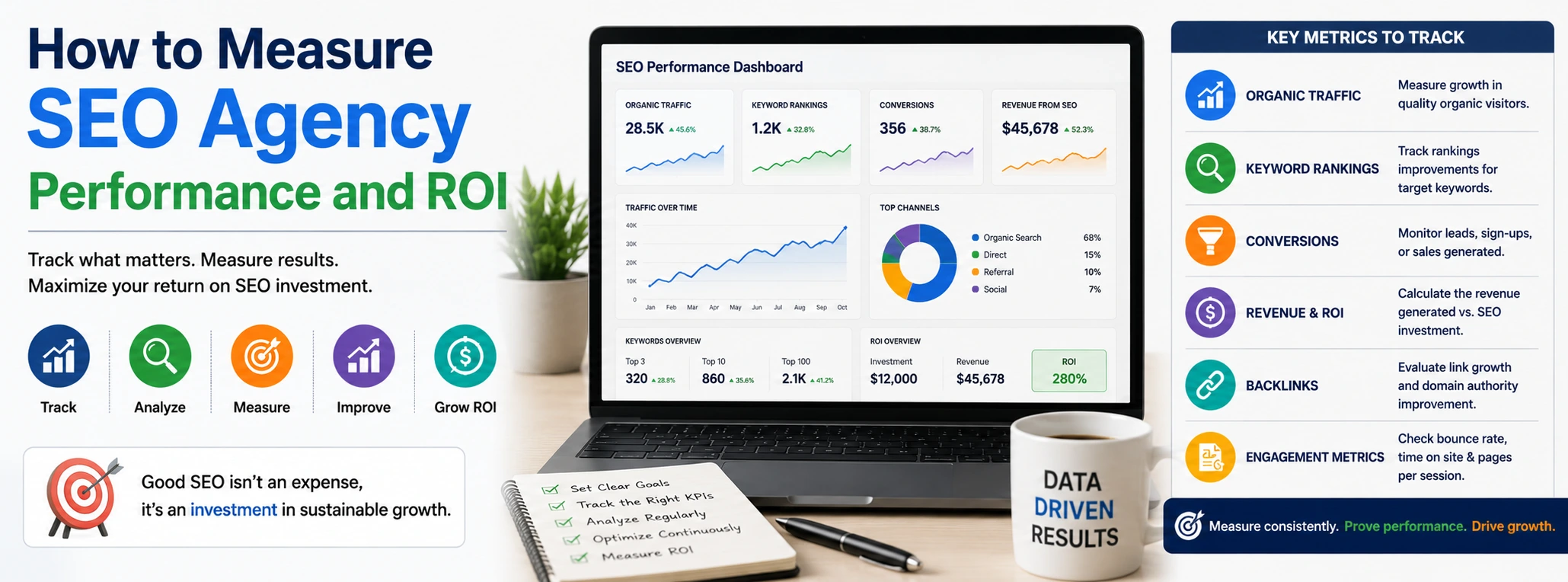
How to Measure SEO Agency Performance and ROI
How do you measure SEO agency performance? SEO agency performance should be measured using a combination of organic traffic, qualified leads, conversions, revenue, search visibility, keyword performance, technical improvements, content growth, and progress toward agreed business goals. Rankings alone are not enough to determine whether an SEO campaign is successful.
Hiring an SEO agency is an investment, so businesses need a clear way to determine whether that investment is producing meaningful results. However, measuring SEO performance can be confusing if you focus only on keyword rankings or total website traffic.
A professional SEO campaign should connect search visibility with real business outcomes such as qualified traffic, leads, sales, conversions, and revenue.
If you are currently evaluating an SEO provider, our guide on how to evaluate an SEO company can help you assess an agency before or during your campaign. You can also review our guide on questions to ask an SEO company before hiring.
Table of Contents
- What Is SEO Agency Performance?
- Why Should You Measure SEO Agency Performance?
- Important SEO KPIs to Track
- 1. Organic Traffic
- 2. Qualified Organic Traffic
- 3. Keyword Rankings
- 4. Search Visibility
- 5. Organic Click-Through Rate
- 6. Organic Leads
- 7. Organic Conversions
- 8. Organic Revenue
- 9. Content Performance
- 10. Technical SEO Improvements
- 11. Relevant Backlinks and Authority
- What Should an SEO Monthly Report Include?
- How to Calculate SEO ROI
- SEO ROI Example
- SEO Vanity Metrics to Avoid
- How Long Should SEO Take to Show Results?
- How to Know If Your SEO Agency Is Doing a Good Job
- SEO Agency Performance Red Flags
- How to Choose a Better SEO Agency
- SEO Performance and ROI FAQs
What Is SEO Agency Performance?
SEO agency performance refers to how effectively an SEO provider improves a website’s organic search visibility and contributes to measurable business outcomes.
A successful SEO campaign can improve:
- Organic search visibility
- Relevant keyword rankings
- Organic website traffic
- Qualified visitors
- Lead generation
- Conversions
- Online sales
- Organic revenue
- Content visibility
- Website quality and technical health
The most important metrics depend on your business model and SEO goals. A local service business, SaaS company, e-commerce store, and national brand may all use different performance indicators.
Why Should You Measure SEO Agency Performance?
SEO is usually a long-term investment. Without proper measurement, it can be difficult to determine whether an agency is creating meaningful progress.
Regular measurement helps businesses:
- Understand whether SEO goals are being achieved
- Identify which SEO activities are producing results
- Find underperforming areas
- Measure organic lead generation
- Understand the value of organic traffic
- Calculate potential SEO ROI
- Make better marketing decisions
- Hold an SEO agency accountable to agreed objectives
Measurement also helps prevent businesses from judging an SEO campaign based on one metric, such as rankings or traffic alone.
Important SEO KPIs to Track
The right SEO KPIs depend on your business objectives. However, most businesses should monitor a combination of visibility, traffic, engagement, conversions, revenue, and technical performance.
1. Organic Traffic
Organic traffic measures how many visitors reach your website through unpaid search results.
Increasing organic traffic can indicate that your website is gaining search visibility. However, more traffic does not automatically mean better SEO performance.
The quality and relevance of that traffic are equally important.
For example, 10,000 visitors who have no interest in your products or services may be less valuable than 1,000 highly relevant visitors who are actively looking for what your business offers.
2. Qualified Organic Traffic
Qualified organic traffic consists of visitors who are relevant to your business and have a reasonable likelihood of becoming customers, leads, or users.
An SEO agency should focus on attracting search traffic that aligns with your target audience and search intent.
This means targeting relevant commercial, transactional, local, and informational queries instead of pursuing traffic simply because a keyword has high search volume.
3. Keyword Rankings
Keyword rankings show where your website appears for specific search queries.
Rankings are useful for understanding search visibility, but they should not be the only SEO KPI.
Consider:
- Which keywords are improving?
- Are the keywords relevant to your business?
- Are commercial keywords improving?
- Are rankings generating clicks?
- Are those clicks producing conversions?
A ranking improvement has greater business value when it leads to relevant traffic and measurable actions.
4. Search Visibility
Search visibility provides a broader view of how prominently your website appears across a group of relevant keywords.
Instead of looking at one keyword, businesses can monitor overall visibility across important topic groups and commercial search terms.
This can provide a more useful picture of organic growth than tracking a handful of keywords.
5. Organic Click-Through Rate
Organic click-through rate, or CTR, measures the percentage of searchers who click your result after seeing it in search results.
CTR can be influenced by:
- Search intent
- Page title
- Meta description
- Search position
- Brand recognition
- Search features
- Competition
If a page receives impressions but very few clicks, the SEO strategy may need to investigate the search intent, page title, content relevance, or search result presentation.
6. Organic Leads
For lead-generation businesses, organic leads are one of the most important SEO performance metrics.
Examples include:
- Contact form submissions
- Quote requests
- Demo requests
- Phone calls
- Consultation bookings
- Email inquiries
Tracking leads helps connect SEO activity to actual business opportunities.
7. Organic Conversions
A conversion occurs when an organic visitor completes a desired action on your website.
Depending on your business, conversions may include:
- Purchases
- Lead submissions
- Phone calls
- Bookings
- Account registrations
- Product inquiries
- Free trial sign-ups
Tracking conversions allows you to determine whether increased organic traffic is actually contributing to business growth.
8. Organic Revenue
For e-commerce and other businesses where revenue can be attributed to organic search, organic revenue is one of the strongest indicators of SEO value.
Revenue tracking can help answer a more important question than “Are my rankings improving?”
“Is organic search generating more business value?”
When possible, connect organic search traffic to transactions, customer value, or revenue so SEO performance can be evaluated from a business perspective.
9. Content Performance
Content is a major part of many SEO campaigns, so businesses should evaluate whether published and optimized content is producing useful results.
Content performance can include:
- Organic impressions
- Organic clicks
- Keyword visibility
- Organic traffic
- Engagement
- Conversions
- Internal link growth
- Topical coverage
A large number of published articles does not automatically indicate SEO success. The quality, relevance, visibility, and business contribution of the content matter more.
10. Technical SEO Improvements
Technical SEO improvements may not immediately appear as traffic or revenue increases, but they can be essential for long-term organic performance.
Depending on the website, an SEO agency may monitor:
- Indexing issues
- Crawlability
- Broken links
- Redirect issues
- Duplicate pages
- Canonical issues
- Site architecture
- Mobile usability
- Page performance
- Structured data
These improvements should be viewed as part of the overall SEO strategy rather than isolated ranking metrics.
11. Relevant Backlinks and Authority
Backlinks can contribute to a website’s authority and discoverability, but the focus should be on relevance and quality rather than acquiring the largest possible number of links.
When evaluating link-building work, ask:
- Are the links relevant to the business?
- Are they earned or acquired through a transparent process?
- Are the referring websites credible?
- Does the strategy support the overall SEO campaign?
A large backlink count alone does not prove that an SEO campaign is successful.
What Should an SEO Monthly Report Include?
A useful SEO monthly report should explain performance in a way that a business owner or marketing team can understand.
An SEO report may include:
- SEO goals
- Work completed
- Organic traffic trends
- Important keyword changes
- Search visibility
- Organic leads
- Conversions
- Revenue where available
- Content published or optimized
- Technical SEO improvements
- Authority-building activities
- Problems identified
- Next month’s priorities
A good report should not simply contain charts. It should explain what the data means and what actions should happen next.
How to Calculate SEO ROI
SEO ROI measures the financial return generated by SEO compared with the cost of the SEO investment.
A simplified SEO ROI formula is:
SEO ROI = (Value Generated by SEO – SEO Investment) ÷ SEO Investment × 100
For example, if SEO generates $20,000 in measurable business value and the SEO investment is $5,000:
($20,000 – $5,000) ÷ $5,000 × 100 = 300% ROI
Actual SEO attribution can be more complicated, particularly for businesses with long sales cycles or multiple marketing channels. Therefore, use the formula as a framework rather than assuming every organic conversion is caused exclusively by SEO.
SEO ROI Example
Imagine a B2B company invests $3,000 per month in SEO.
After organic search improvements, the website generates 25 additional qualified leads per month. If those leads result in $12,000 of attributable business value, the company can compare that value with the $3,000 SEO investment.
The exact calculation will depend on how the company defines revenue, customer value, attribution, and acquisition costs.
This is why SEO reporting should connect search metrics with actual business outcomes whenever possible.
SEO Vanity Metrics to Avoid
Some metrics can look impressive without demonstrating meaningful business value.
Be cautious when an SEO agency focuses almost entirely on:
- Total backlink counts
- Large numbers of published articles
- Keyword rankings without business relevance
- Total impressions without conversions
- Traffic from unrelated keywords
- Domain metrics without context
These metrics can still provide useful information, but they should be considered alongside qualified traffic, leads, conversions, revenue, and strategic progress.
How Long Should SEO Take to Show Results?
There is no fixed timeline for SEO results.
The timeframe can depend on:
- Website authority
- Industry competition
- Technical website condition
- Content quality
- Existing search visibility
- Target keywords
- Website size
- SEO investment
- Quality of implementation
A reputable SEO agency should explain what milestones it expects to achieve rather than promising instant rankings or guaranteed results.
How to Know If Your SEO Agency Is Doing a Good Job
A good SEO agency should be able to explain what it is doing, why it is doing it, and how the work supports your business objectives.
Positive signs include:
- Clear SEO goals
- A documented strategy
- Consistent implementation
- Transparent reporting
- Relevant keyword growth
- Improved organic visibility
- Growth in qualified organic traffic
- Improved lead or conversion opportunities
- Regular communication
- Continuous testing and optimization
The agency should also be willing to explain setbacks and adjust the strategy when the data indicates that something is not working.
SEO Agency Performance Red Flags
Be cautious if an SEO agency:
- Guarantees specific Google rankings
- Promises instant results
- Cannot explain its SEO strategy
- Provides reports without meaningful analysis
- Focuses only on rankings
- Reports large amounts of irrelevant traffic
- Cannot explain where backlinks come from
- Publishes content without a clear strategy
- Does not communicate regularly
- Cannot connect SEO activity to your business goals
If you are seeing these warning signs, review your campaign and discuss expectations with your SEO provider before deciding whether a change is necessary.
How to Choose a Better SEO Agency
The best SEO agency is not necessarily the agency with the lowest price or the biggest list of services. Look for a provider that understands your industry, audience, competitors, website, and business objectives.
Before hiring an agency, consider its:
- SEO experience
- Strategy and methodology
- Case studies
- Technical expertise
- Content capabilities
- Reporting process
- Communication
- Pricing transparency
- Understanding of your business goals
For a complete selection process, read our guide on how to choose an SEO company.
You can also learn more about what an SEO company actually does before comparing potential providers.
How SEO Reporting Supports AEO and GEO
Modern search visibility is no longer limited to traditional blue-link rankings. Businesses also need to consider how their content can be understood and surfaced by answer engines and generative search experiences.
Clear information architecture, authoritative content, accurate business information, strong topical coverage, useful answers, and consistent brand signals can help search systems better understand a business and its expertise.
For this reason, SEO measurement should look beyond rankings and include broader indicators of visibility, relevance, content quality, and business outcomes.
A strong SEO strategy should therefore support traditional search optimization while also creating content that clearly answers user questions and establishes the business as a credible source within its topic.
Why Choose eBizInfoSys for SEO Services?
Choosing the right SEO company can directly influence your website’s organic visibility, qualified traffic, lead generation, and digital growth.
At eBizInfoSys, we create customized SEO strategies based on business objectives, target customers, industry competition, website performance, and search opportunities.
With 17+ years of experience, our approach focuses on:
- Customized SEO Strategies:
SEO plans designed around your business goals instead of generic packages. - Technical SEO Expertise:
Improving crawlability, indexing, website performance, technical health, and search accessibility. - Content Optimization:
Developing content strategies based on search intent, topical relevance, expertise, and user experience. - Transparent Reporting:
Clear reporting focused on completed work, performance insights, opportunities, and next steps. - Ethical SEO Practices:
Sustainable optimization strategies designed for long-term organic growth. - Business Growth Focus:
Connecting SEO activity with qualified traffic, leads, conversions, and broader business objectives.
Explore our SEO services to learn more about how we approach sustainable search visibility and organic growth.
About the Author
Written by Rohit Jarial, an SEO professional specializing in technical SEO, content optimization, keyword research, and organic growth strategies.
Rohit Jarial helps businesses improve online visibility through ethical SEO practices, data-driven optimization, and sustainable digital marketing strategies.
Frequently Asked Questions About SEO Performance and ROI
How do I know if my SEO agency is doing a good job?
Evaluate whether your SEO agency is making measurable progress toward agreed goals. Look at organic visibility, relevant rankings, qualified traffic, leads, conversions, revenue, technical improvements, content performance, reporting quality, and communication.
What KPIs should an SEO agency report?
An SEO agency should report KPIs relevant to the business, which may include organic traffic, search visibility, keyword performance, qualified leads, conversions, revenue, content performance, technical improvements, and other agreed objectives.
How do you calculate SEO ROI?
A simplified formula is: SEO ROI = (value generated by SEO minus SEO investment) divided by SEO investment, multiplied by 100. The exact calculation depends on how revenue and conversions are attributed to organic search.
What should an SEO monthly report include?
An SEO monthly report should explain completed work, organic performance, important keyword changes, traffic, conversions, content activity, technical improvements, issues, and the priorities for the next reporting period.
How long should I give an SEO agency to show results?
SEO timelines vary based on competition, website condition, authority, content quality, target keywords, and implementation. Instead of expecting an instant result, evaluate progress against realistic milestones and business objectives.
Are keyword rankings enough to measure SEO success?
No. Keyword rankings are useful, but SEO success should also be evaluated through relevant organic traffic, leads, conversions, revenue, search visibility, content performance, and progress toward business goals.
What is the most important SEO KPI?
There is no single KPI that is most important for every business. For many businesses, qualified organic leads, conversions, and revenue are more meaningful than rankings or traffic alone.
Can SEO ROI be measured for a small business?
Yes. Small businesses can measure SEO performance through organic traffic, calls, form submissions, bookings, inquiries, sales, and other valuable customer actions. The tracking method should match the business model.
Choose an SEO Partner Focused on Measurable Growth
SEO should be treated as a business investment, not simply a ranking exercise. The right SEO partner should help you understand where your website stands, what opportunities exist, what work needs to be completed, and how that work contributes to measurable growth.
A strong SEO strategy combines technical optimization, useful content, search intent, authority, measurement, and continuous improvement.
If you are looking for an SEO partner that focuses on strategy, transparency, measurable performance, and sustainable organic growth, contact our SEO team to discuss your website and business goals.
Final Takeaway
The best way to measure SEO agency performance is to look beyond keyword rankings and total traffic. Evaluate the complete picture: search visibility, qualified organic traffic, leads, conversions, revenue, content performance, technical improvements, and progress toward your business objectives.
SEO takes time, and not every improvement will immediately produce revenue. However, a professional SEO agency should be able to explain its strategy, demonstrate measurable progress, provide transparent reporting, and adjust its approach based on data.
The goal is not simply to rank higher. The goal is to build sustainable organic visibility that attracts the right audience and creates measurable business value.
Before choosing an SEO provider, read our complete guide on how to choose an SEO company, learn how to evaluate an SEO company, and review the questions to ask an SEO company before hiring.