


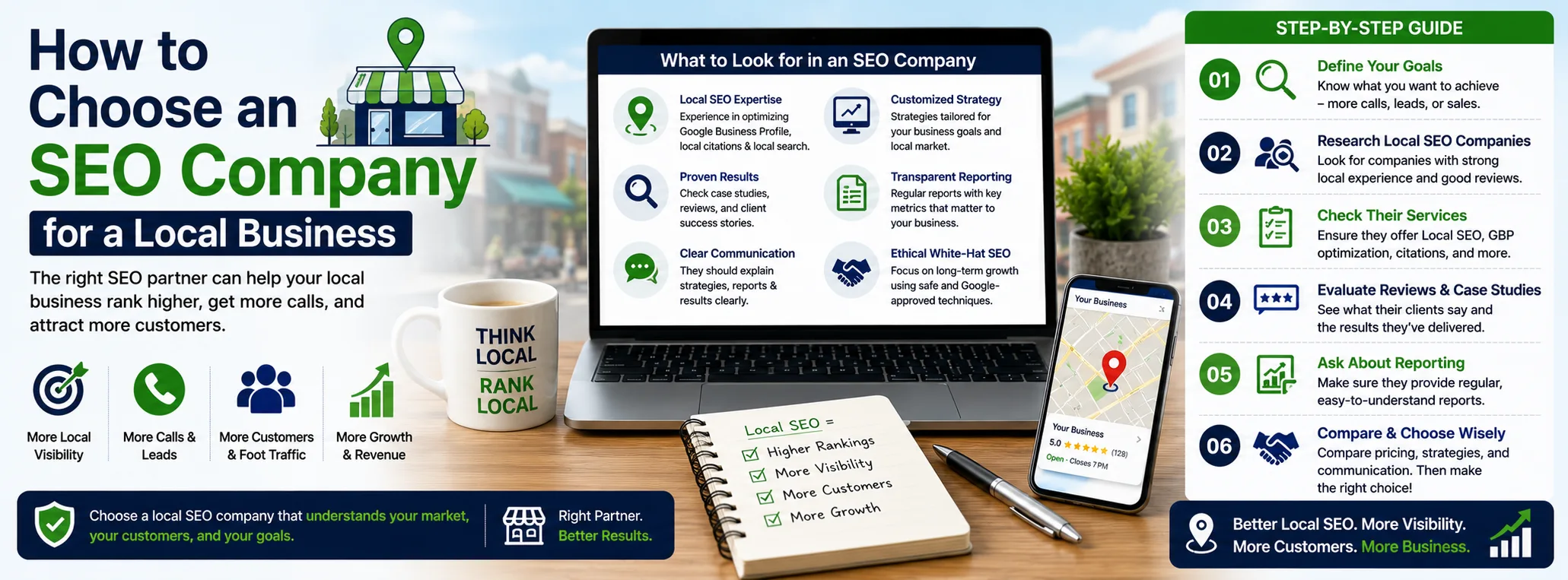
How to Choose an SEO Company for a Local Business
Choosing the right SEO company can make a significant difference for a local business that wants to attract more customers from search engines. A strong local SEO strategy can help your business improve its visibility for relevant searches, reach customers in your service area, generate qualified leads, and build long-term organic growth.
However, not every SEO agency has the same level of local search experience. When choosing a local SEO company, you need to look beyond pricing and rankings and evaluate the agency’s strategy, Google Business Profile expertise, keyword research, location targeting, content, technical SEO, reporting, and ability to connect SEO performance with real business results.
The best way to choose an SEO company for a local business is to evaluate its local SEO experience, strategy, Google Business Profile approach, content and location-page strategy, technical expertise, reporting, pricing, and ability to generate qualified local leads.
If you are still comparing SEO providers, start with our complete guide on how to choose an SEO company. You can also learn how to choose an SEO company for a small business.
Table of Contents
- What Is Local SEO?
- Why Local Businesses Need Local SEO
- What Does a Local SEO Company Do?
- How to Choose an SEO Company for a Local Business
- 1. Check Local SEO Experience
- 2. Review Local SEO Case Studies
- 3. Evaluate the Google Business Profile Strategy
- 4. Check Local Keyword Research
- 5. Evaluate Location and Service Pages
- 6. Review the Local Content Strategy
- 7. Ask About Reviews and Reputation
- 8. Evaluate Technical SEO
- 9. Understand Local SEO Reporting
- 10. Compare Pricing and Deliverables
- Local SEO vs Traditional SEO
- What Should a Local SEO Package Include?
- Local SEO Company Red Flags
- Questions to Ask a Local SEO Company
- SEO, AEO, and GEO for Local Businesses
- How Long Does Local SEO Take?
- Local SEO Company Checklist
- Frequently Asked Questions
- Final Takeaway
What Is Local SEO?
Local SEO is the process of improving a business’s online visibility for searches that have local intent. These searches can include services, products, businesses, and questions connected to a specific city, region, neighborhood, or service area.
For example, someone searching for a plumber, dentist, restaurant, lawyer, roofing company, or marketing agency in a particular location may be looking for a local business they can contact or visit.
Local SEO can involve your website, Google Business Profile, business information, local content, reviews, location pages, technical SEO, and other relevant online signals.
Google explains that businesses can manage how their information appears across Google Search and Maps through a Business Profile. Keeping important business information accurate can help customers discover and understand the business. Google’s guidance on establishing business details provides additional information.
Why Local Businesses Need Local SEO
Local customers often use search engines to find businesses that can solve an immediate need.
A strong local SEO presence can help your business become more visible when potential customers search for services or products you offer in your target area.
Local SEO can support the following:
- Local search visibility
- Google Search and Maps discovery
- Qualified website traffic
- Phone calls and inquiries
- Appointment requests
- Store visits
- Local brand awareness
- Long-term organic growth
The goal should not simply be to rank for a large number of local keywords. The goal is to become more visible to people who are genuinely relevant to your business.
What Does a Local SEO Company Do?
A local SEO company helps businesses improve their visibility for relevant searches in their target geographic areas.
Depending on your business, local SEO services may include the following:
- Local SEO audits
- Google Business Profile optimization
- Local keyword research
- Competitor analysis
- Location page optimization
- Service page optimization
- Local content strategy
- Review and reputation recommendations
- Local citation management
- Technical SEO
- On-page SEO
- Internal linking
- Local authority-building activities
- Conversion optimization
- SEO reporting
The exact scope should depend on your website, market, competition, business model, and goals.
How to Choose an SEO Company for a Local Business
Choosing a local SEO company should involve more than comparing monthly prices. You need to determine whether the agency understands your customers, service area, competitors, website, and business objectives.
Use the following factors to compare potential local SEO partners.
1. Check Local SEO Experience
Local SEO requires an understanding of how customers search for businesses in specific geographic markets.
Ask the SEO company whether it has experience with businesses similar to yours.
Useful questions include:
- Have you worked with local businesses in my industry?
- Have you handled multi-location businesses?
- Have you worked in competitive local markets?
- How do you approach local keyword research?
- How do you optimize local service pages?
- How do you approach Google Business Profile optimization?
Relevant experience is more useful than simply knowing how many years an agency has been in business.
2. Review Local SEO Case Studies
Case studies can help you understand how an agency approaches local SEO campaigns.
When reviewing a case study, look beyond a statement such as “organic traffic increased by 200%.”
Ask:
- What was the business’s starting position?
- What geographic area was targeted?
- Which services or products were prioritized?
- What SEO problems were identified?
- What changes were implemented?
- How long did the campaign take?
- Did qualified leads or conversions improve?
The best case studies explain the strategy and connect SEO improvements with meaningful business outcomes.
3. Evaluate the Google Business Profile Strategy
For businesses that serve local customers, Google Business Profile can be an important part of the local search strategy.
Ask your SEO company how it plans to manage and improve your business profile.
The strategy may involve:
- Accurate business information
- Business category selection
- Services and products where applicable
- Business description
- Photos and visual information
- Review management recommendations
- Local relevance
- Monitoring and optimization
Your business should retain appropriate ownership and administrative access to its business profile and other important digital assets.
4. Check Local Keyword Research
A local SEO company should understand the difference between generic keywords and searches that indicate local intent.
Depending on your business, keyword research may include the following:
- Service keywords
- Product keywords
- City-based searches
- Location-based searches
- Near-me searches
- Problem-based searches
- Commercial searches
- Question-based searches
However, an effective local SEO strategy should not simply create a separate page for every possible keyword variation.
Keywords should be grouped according to search intent and supported by useful, relevant content.
5. Evaluate Location and Service Pages
Location and service pages can be useful when they provide genuinely useful information for customers.
A strong local landing page may explain the following:
- The service offered
- Who the service is for
- The locations served
- Relevant local information
- How customers can get started
- Frequently asked questions
- Trust and credibility information
- Clear contact options
Avoid agencies that recommend creating large numbers of nearly identical location pages with little useful information. Local content should provide genuine value rather than simply repeating city names.
6. Review the Local Content Strategy
Local content can help a business demonstrate expertise and answer questions from customers in its target market.
Depending on your business, content opportunities may include the following:
- Local service guides
- Frequently asked questions
- Location-specific service information
- Buying guides
- Local problem-solving content
- Service comparisons
- Customer education resources
- Industry-specific local information
Good content should be written primarily to help customers rather than simply to insert keywords.
7. Ask About Reviews and Reputation
Reviews can influence how customers perceive a local business and can be an important part of a broader local marketing strategy.
Ask your SEO company how it recommends handling reviews.
A responsible approach should focus on encouraging genuine customer feedback and responding appropriately to reviews.
Be cautious of any agency that suggests creating fake reviews or manipulating customer feedback.
8. Evaluate Technical SEO
Local SEO still depends on a technically sound website.
Your SEO company should be able to identify and prioritize technical issues involving the following:
- Crawlability
- Indexing
- Site architecture
- Internal linking
- Canonical URLs
- Duplicate content
- Mobile usability
- Page experience
- Structured data where appropriate
Technical recommendations should be prioritized according to their potential impact rather than presented as a long list of minor issues.
9. Understand Local SEO Reporting
Before signing a contract, ask what your local SEO reports will contain.
A useful report may include:
- Organic traffic
- Local search visibility
- Important keyword trends
- Search impressions
- Website conversions
- Phone calls or inquiries where tracking is available
- Business Profile insights where applicable
- Content performance
- Technical SEO improvements
- Completed work
- Next priorities
Learn more about how to measure SEO agency performance and SEO ROI.
10. Compare Pricing and Deliverables
Local SEO pricing varies depending on the business, target market, competition, website size, number of locations, services required, and campaign scope.
Do not compare agencies based only on their monthly price.
Instead, compare:
- Services included
- Monthly deliverables
- Content included
- Technical SEO work
- Local SEO work
- Reporting
- Communication
- Contract length
- Additional fees
For more information about SEO costs, read our complete SEO pricing guide.
Local SEO vs Traditional SEO
Local SEO and broader organic SEO share many fundamentals, but the focus can be different.
Traditional SEO may focus heavily on broader organic visibility, while local SEO also considers geographic relevance and local customer intent.
A local SEO campaign may place greater emphasis on:
- Google Business Profile
- Local search intent
- Location pages
- Local content
- Reviews
- Local business information
- Local competitors
Many businesses benefit from combining local SEO with broader technical, content, and on-page SEO.
What Should a Local SEO Package Include?
There is no universal local SEO package that is right for every business.
Depending on your requirements, a local SEO package may include the following:
- Initial SEO audit
- Local SEO audit
- Keyword research
- Competitor analysis
- Google Business Profile optimization
- On-page SEO
- Technical SEO
- Service page optimization
- Location page optimization
- Local content
- Internal linking
- Local citation recommendations
- Review strategy
- Local authority-building activities
- Conversion optimization
- Monthly reporting
Your agency should explain which services are necessary for your business and why.
Local SEO Company Red Flags
Be cautious of a local SEO company:
- Guarantees a number-one ranking
- Promises instant local rankings
- Creates large numbers of low-quality location pages
- Uses fake reviews
- Cannot explain its local SEO strategy
- Focuses only on keyword rankings
- Offers thousands of backlinks for a very low price
- Uses automated or manipulative techniques without explanation
- Provides vague monthly reports
- Hides additional charges
- Does not give you appropriate access to your digital assets
Google explicitly warns that no one can guarantee a number-one ranking in Google Search. Be especially cautious when an agency uses guaranteed rankings as its primary sales pitch.
Questions to Ask a Local SEO Company
Before hiring a local SEO agency, ask:
- Have you worked with businesses in my industry?
- Have you worked in my target geographic market?
- What local SEO issues do you see on my website?
- How will you approach my Google Business Profile?
- How will you perform local keyword research?
- How will you decide which pages need optimization?
- Will you create or optimize location pages?
- What type of local content do you recommend?
- How do you approach reviews?
- How do you approach local link building or authority development?
- How will technical SEO be handled?
- Which KPIs will you track?
- How often will I receive reports?
- Who will manage my campaign?
- What is included in the monthly price?
- Are there additional fees?
- What is the contract length?
For more questions to ask before hiring an agency, see our guide on questions to ask an SEO company before hiring.
SEO, AEO, and GEO for Local Businesses
Search is expanding beyond traditional blue-link results. Customers can also discover information through conversational search, answer-focused experiences, maps, business profiles, and generative AI interfaces.
A modern local SEO strategy should therefore focus on creating clear, useful, trustworthy information about your business.
This can include:
- Accurate business information
- Clear service descriptions
- Location relevance
- Helpful customer questions and answers
- Strong topical coverage
- Consistent business information
- Useful first-hand local content
- Clear expertise and trust signals
- Appropriate structured data
Answer Engine Optimization (AEO) focuses on making useful information easier for answer-oriented search experiences to understand, while Generative Engine Optimization (GEO) generally refers to improving the likelihood that a brand or its information is represented accurately across generative search experiences.
These approaches should complement—not replace—strong technical SEO, useful content, local relevance, and a high-quality website.
How Long Does Local SEO Take?
There is no fixed timeline for local SEO results.
Performance can depend on your starting position, competition, website quality, authority, geographic market, content, technical issues, and the amount of work implemented.
Some improvements may become visible relatively quickly, while broader organic growth can require considerably more time.
A professional SEO company should set realistic expectations and measure progress using agreed KPIs instead of promising immediate rankings.
Local SEO Company Checklist
Before hiring a local SEO company, use this checklist:
- Define your local SEO goals
- Identify your target locations
- Identify your most valuable services or products
- Review your current website
- Check your current local search presence
- Review the agency’s local SEO experience
- Review relevant case studies
- Ask about Google Business Profile optimization
- Ask about local keyword research
- Ask about location and service pages
- Ask about content strategy
- Ask about technical SEO
- Ask about reviews and reputation
- Review SEO reporting
- Compare pricing and deliverables
- Review contract terms
- Avoid guaranteed ranking promises
How Our Local SEO Approach Can Help Your Business
Every local business has different customers, competitors, services, locations, and growth objectives. That is why effective local SEO should begin with understanding the business rather than applying a generic checklist.
Our SEO approach can help identify opportunities across technical SEO, local search visibility, keyword strategy, content, service pages, location relevance, internal linking, conversion opportunities, and performance measurement.
We focus on connecting search visibility with the people who are most likely to become customers—not simply increasing traffic for the sake of traffic.
Want to know what is preventing your local business website from reaching more potential customers? Get Your SEO Audit
Why Choose eBizInfoSys for SEO Services?
Choosing the right SEO company can directly influence your website’s organic visibility, qualified traffic, lead generation, and digital growth.
At eBizInfoSys, we create customized SEO strategies based on business objectives, target customers, industry competition, website performance, and search opportunities.
With 17+ years of experience, our approach focuses on:
- Customized SEO Strategies:
SEO plans designed around your business goals instead of generic packages. - Technical SEO Expertise:
Improving crawlability, indexing, website performance, technical health, and search accessibility. - Content Optimization:
Developing content strategies based on search intent, topical relevance, expertise, and user experience. - Transparent Reporting:
Clear reporting focused on completed work, performance insights, opportunities, and next steps. - Ethical SEO Practices:
Sustainable optimization strategies designed for long-term organic growth. - Business Growth Focus:
Connecting SEO activity with qualified traffic, leads, conversions, and broader business objectives.
Explore our SEO services to learn more about how we approach sustainable search visibility and organic growth.
About the Author
Written by Rohit Jarial, an SEO professional specializing in technical SEO, content optimization, keyword research, and organic growth strategies.
Rohit Jarial helps businesses improve online visibility through ethical SEO practices, data-driven optimization, and sustainable digital marketing strategies.
Frequently Asked Questions
How do I choose an SEO company for a local business?
Choose an SEO company based on its local SEO experience, strategy, Google Business Profile knowledge, keyword research, technical SEO capabilities, content approach, reporting, pricing, communication, and ability to connect SEO performance with business goals.
What does a local SEO company do?
A local SEO company helps improve a business’s visibility for relevant local searches. Services can include Google Business Profile optimization, local keyword research, on-page SEO, technical SEO, location pages, local content, competitor analysis, reputation recommendations, and reporting.
How much does local SEO cost?
Local SEO costs vary depending on the business, competition, target locations, website size, services required, and campaign scope. Compare the strategy and deliverables instead of choosing an agency based only on price.
Is local SEO worth it for a small business?
Local SEO can be valuable for small businesses that depend on customers in a specific geographic area. It can help improve visibility for relevant local searches and create opportunities for qualified website visits, calls, inquiries, appointments, or visits.
What should a local SEO package include?
A local SEO package may include a local SEO audit, keyword research, Google Business Profile optimization, on-page SEO, technical SEO, location pages, local content, internal linking, reputation recommendations, authority-building activities, and performance reporting.
How long does local SEO take to work?
There is no universal timeline. Results depend on competition, website condition, authority, content, technical SEO, location, search demand, and the strategy being implemented. A reputable agency should provide realistic expectations instead of guaranteeing immediate rankings.
Can a local SEO company guarantee Google rankings?
No legitimate SEO company can guarantee a specific Google ranking position. Search rankings depend on many factors outside an agency’s direct control.
What are the biggest local SEO agency red flags?
Major warning signs include guaranteed rankings, fake reviews, low-quality location pages, unclear strategies, manipulative link-building methods, vague reporting, hidden fees, and promises of instant results.
Final Takeaway
Choosing an SEO company for a local business requires more than comparing monthly prices. You need a partner that understands local search intent, your target market, your customers, your services, and the competitive environment.
Before hiring an agency, evaluate its local SEO experience, Google Business Profile strategy, keyword research, content approach, location pages, technical SEO capabilities, reporting, pricing, communication, and contract terms.
The right local SEO partner should help your business build sustainable visibility, attract relevant local customers, generate qualified leads, and create long-term organic growth.
If you want to understand where your website currently stands and which local SEO opportunities you may be missing, contact our SEO team or learn more about an SEO audit.