


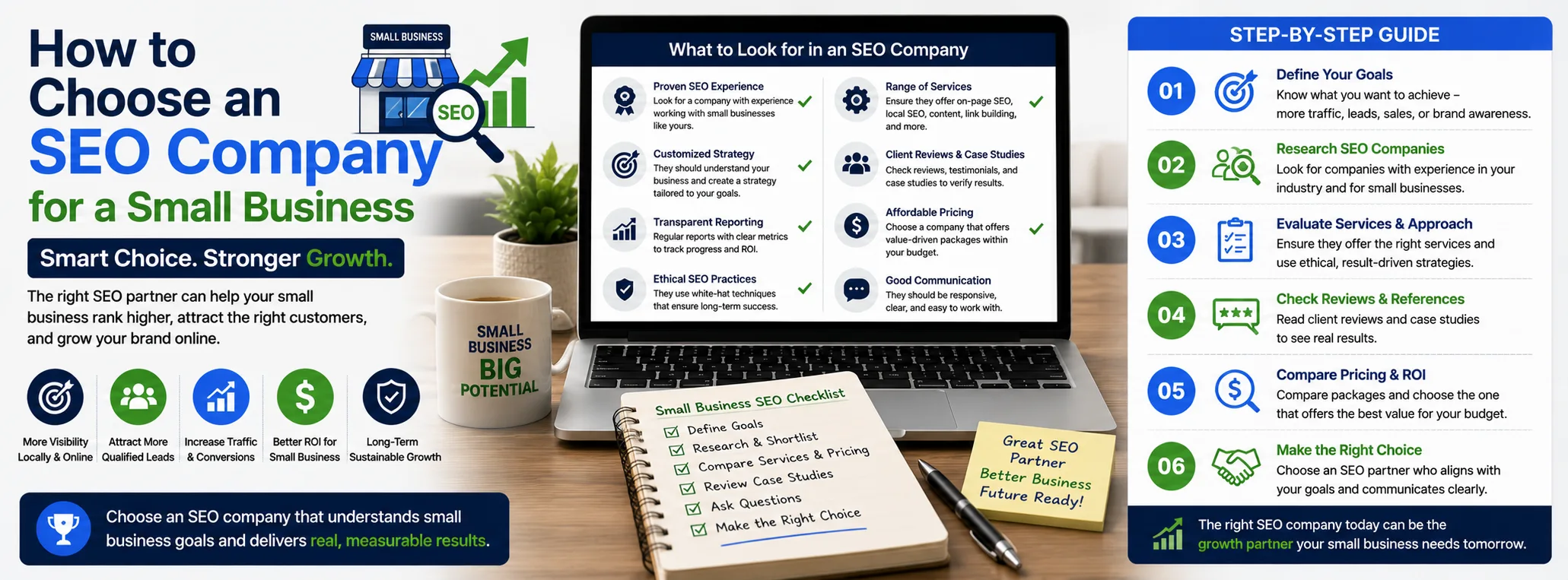
How to Choose an SEO Company for a Small Business
Choosing the right SEO company can be one of the most important marketing decisions for a small business. The right SEO partner can help improve organic visibility, attract qualified website visitors, generate leads, and build sustainable online growth.
However, not every SEO company is the right fit for a small business. Agencies differ in their experience, pricing, services, communication, strategy, reporting, and approach to SEO.
If you are comparing SEO providers, this guide explains how to choose an SEO company for a small business, what services to look for, what questions to ask, how to compare pricing, and which red flags to avoid.
If you are still at the beginning of your search, start with our complete guide on how to choose an SEO company. You can also learn how to evaluate an SEO company before making a final decision.
Table of Contents
- Why Small Businesses Need the Right SEO Company
- What Should a Small Business Look for in an SEO Company?
- What SEO Services Should a Small Business Expect?
- Check the Company’s SEO Experience
- Evaluate the SEO Strategy
- Check Local SEO Expertise
- Evaluate Content and Keyword Strategy
- Review Technical SEO Capabilities
- Compare Small Business SEO Pricing
- Review Case Studies and Results
- Understand SEO Reporting and KPIs
- Ask About SEO, AEO and GEO
- SEO Agency Red Flags for Small Businesses
- Questions to Ask Before Hiring an SEO Company
- Review the SEO Contract
- Small Business SEO Company Checklist
- Frequently Asked Questions
- Final Takeaway
Why Small Businesses Need the Right SEO Company
Small businesses often have more limited marketing budgets and resources than large companies. That makes choosing the right SEO partner especially important.
A good SEO strategy should focus on the search terms, customers, locations, products, and services that matter most to your business instead of trying to rank for every possible keyword.
For many small businesses, SEO can support:
- More relevant organic website traffic
- Local search visibility
- Qualified leads
- Service and product discovery
- Brand visibility
- Long-term organic growth
Google also notes that small local businesses can handle many SEO activities themselves, but professional SEO support can be useful when a business needs additional expertise or resources.
What Should a Small Business Look for in an SEO Company?
The best SEO company for a small business is not necessarily the cheapest agency or the largest agency. It should be a provider that understands your market, goals, customers, competition, and available resources.
Look for an SEO company that provides:
- A clear SEO strategy
- Relevant industry experience
- Transparent pricing
- Clear deliverables
- Technical SEO expertise
- Content strategy
- Local SEO knowledge when relevant
- Transparent reporting
- Business-focused KPIs
- Consistent communication
- Realistic expectations
Your SEO company should also explain why specific work is recommended rather than simply giving you a list of monthly tasks.
What SEO Services Should a Small Business Expect?
SEO services vary by business and industry. A good campaign should be based on your website and goals rather than a generic package.
Depending on your needs, small business SEO services may include:
- SEO audit
- Keyword research
- Search intent analysis
- On-page SEO
- Technical SEO
- Content strategy
- Blog content
- Service page optimization
- Internal linking
- Local SEO
- Google Business Profile optimization
- Competitor analysis
- Authority and link-building strategy
- Conversion optimization recommendations
- SEO reporting
Not every small business needs every service. The right SEO company should prioritize the work that can have the greatest impact on your specific website and audience.
Check the Company’s SEO Experience
Experience matters because different businesses have different SEO challenges.
For example, a local service business may need a strong local search strategy, while an e-commerce company may require technical optimization across hundreds or thousands of product pages.
Ask potential SEO companies:
- How long have you been providing SEO services?
- Have you worked with businesses similar to mine?
- Do you understand my industry?
- Can you explain examples of previous SEO campaigns?
- Who will actually manage my SEO campaign?
Experience should not be judged only by the number of years an agency has existed. Look for evidence that the team understands the type of SEO challenges your business actually faces.
Evaluate the SEO Strategy
A professional SEO company should be able to explain its approach before you sign a long-term agreement.
A small business SEO strategy may include:
- Website and technical SEO analysis
- Keyword and search intent research
- Competitor analysis
- Content gap analysis
- On-page optimization
- Internal linking improvements
- Local SEO optimization when relevant
- Authority-building activities
- Conversion optimization
- Performance tracking and reporting
The strategy should evolve as performance data becomes available.
Be cautious if an agency presents the same generic SEO package to every business without first reviewing your website, competitors, industry, and goals.
Check Local SEO Expertise
If your small business serves a specific city, region, or service area, local SEO may be an important part of your strategy.
Local SEO can involve:
- Google Business Profile optimization
- Local keyword research
- Location and service-area pages
- Local business information
- Reviews and reputation signals
- Relevant local citations
- Locally relevant content
- Local competitor research
Google explains that claiming and maintaining a Business Profile can help businesses manage how their information appears across Google Search and Maps.
If local customers are important to your business, make sure the SEO company you hire understands local search rather than focusing exclusively on national organic rankings.
Evaluate Content and Keyword Strategy
Content should be created to answer real customer questions and support your products or services.
A good small business SEO content strategy may target:
- Commercial keywords
- Service-related searches
- Location-based searches
- Problem-based searches
- Frequently asked questions
- Comparison searches
- Informational searches
For example, instead of creating dozens of low-value pages around slightly different keyword variations, an SEO company should help build useful content that genuinely answers customer needs.
Google recommends people-first content that is useful, reliable, original, and created to help visitors rather than content produced primarily to manipulate search rankings.
Review Technical SEO Capabilities
Technical SEO helps search engines crawl, understand, and index your website effectively.
A small business website may need technical attention involving:
- Indexing
- Crawlability
- Site architecture
- URL structure
- Internal linking
- Duplicate content
- Canonicalization
- Page performance
- Mobile usability
- Structured data where appropriate
Google’s technical requirements state that pages need to be accessible to Googlebot, return a successful HTTP response, and contain indexable content to be eligible for indexing.
Your SEO company should be able to identify technical problems and explain which issues are important enough to prioritize.
Compare Small Business SEO Pricing
SEO pricing varies based on the website, competition, industry, goals, services required, and amount of work involved.
Common SEO pricing models include:
- Monthly SEO retainers
- One-time SEO projects
- SEO audits
- Hourly consulting
- Custom SEO packages
Do not choose an SEO company simply because it offers the lowest monthly price.
Instead, compare:
- What work is included
- How many pages will be optimized
- Whether content is included
- Whether technical implementation is included
- How reporting works
- Who manages the campaign
- Whether there are additional fees
- Contract length and cancellation terms
For a detailed breakdown, read our complete SEO pricing guide.
Review Case Studies and Results
Case studies can help you understand how an SEO company approaches real campaigns.
However, do not look only for impressive traffic percentages.
Ask:
- What was the starting situation?
- What strategy was implemented?
- How long did the campaign run?
- Which keywords or topics were targeted?
- Did qualified traffic increase?
- Did leads or conversions improve?
- What work was actually performed?
The most useful case studies connect SEO activity with meaningful business outcomes.
Understand SEO Reporting and KPIs
Before hiring an SEO company, ask what your monthly reports will contain.
A useful SEO report may cover:
- Organic traffic
- Search impressions
- Click-through rate
- Keyword visibility
- Organic conversions
- Qualified leads
- Content performance
- Technical SEO improvements
- Completed tasks
- Next-month priorities
Your SEO KPIs should reflect your business objectives. For a lead-generation business, leads and qualified inquiries may matter more than traffic alone.
Learn more about how to measure SEO agency performance and ROI.
Ask About SEO, AEO, and GEO
Search behavior continues to evolve. Businesses should consider how their content can be understood and surfaced across traditional search, answer-focused experiences, and generative search experiences.
When evaluating an SEO company, ask how its strategy addresses:
- Traditional organic search
- Search intent
- Question-based queries
- Answer Engine Optimization (AEO)
- Generative Engine Optimization (GEO)
- Entity relationships
- Topical authority
- Structured information
- Expertise and trust
AEO and GEO should support a strong SEO foundation. They should not be presented as shortcuts to guaranteed visibility in AI-generated answers or search results.
SEO Agency Red Flags for Small Businesses
Be careful with an SEO company:
- Guarantees number-one Google rankings
- Promises instant results
- Cannot explain its strategy
- Uses vague monthly deliverables
- Focuses only on keyword rankings
- Offers unusually large numbers of backlinks for a very low price
- Uses unclear or risky SEO methods
- Hides additional fees
- Refuses to provide meaningful reporting
- Pressures you to sign immediately
No SEO company can guarantee a specific Google ranking position. Google itself explains that there are no secret methods that automatically guarantee a first-place ranking.
Questions to Ask Before Hiring an SEO Company
Before choosing an agency, ask:
- Have you worked with businesses similar to mine?
- What SEO problems do you see on my website?
- What would your first 90 days look like?
- Which SEO services are included?
- Who will manage my campaign?
- How will you measure SEO success?
- What will be included in monthly reports?
- How do you approach content?
- How do you approach link acquisition?
- How do you handle technical SEO?
- Do you provide local SEO?
- How do you approach AEO and GEO?
- What does your SEO pricing include?
- Is there a minimum contract period?
- How often will we communicate?
For a more detailed list, read our guide on questions to ask an SEO company before hiring.
Review the SEO Contract.
Never sign an SEO agreement without understanding the terms.
Check:
- Monthly fees
- Setup fees
- Contract duration
- Cancellation policy
- Notice period
- Included deliverables
- Content ownership
- Website access
- Reporting responsibilities
- Additional service charges
Understanding the contract before starting can prevent unexpected costs and disagreements later.
How Long Does Small Business SEO Take?
There is no universal timeline for SEO results.
The time required depends on factors such as your website’s current condition, competition, content quality, authority, technical issues, target market, and the work being implemented.
Some improvements may be reflected relatively quickly, while broader organic growth can take considerably longer. Google notes that changes can take anywhere from hours to months to be reflected in Search and recommends giving changes enough time before evaluating their impact.
A good SEO company should therefore provide realistic milestones instead of promising instant rankings.
Should a Small Business Hire an SEO Agency or Do SEO In-House?
Both approaches can work.
Doing SEO internally may make sense when you have the necessary knowledge, time, and resources. Hiring an SEO company can be useful when you need specialized expertise or do not have enough internal capacity.
The decision should be based on your goals, resources, website complexity, competition, and available budget.
Small Business SEO Company Checklist
Use this checklist before choosing an SEO company:
- Define your SEO goals
- Identify your target audience
- Understand your competitors
- Review your current website performance
- Request an SEO audit or assessment
- Check relevant experience
- Review case studies
- Compare SEO services
- Compare pricing and deliverables
- Ask about technical SEO
- Ask about content strategy
- Ask about local SEO if relevant
- Ask about AEO and GEO
- Review reporting and KPIs
- Check contract terms
- Confirm communication expectations
- Avoid guaranteed ranking promises
How Our SEO Approach Can Help Small Businesses
Every small business has different SEO requirements. Instead of applying the same checklist to every website, an effective SEO campaign should begin by understanding your business, audience, competitors, website, and growth goals.
Our approach can focus on the areas that matter most to your business, including technical SEO, keyword strategy, content optimization, internal linking, local search visibility, organic growth, conversion opportunities, and performance measurement.
We also build content around real customer questions and search intent so that your website can provide useful answers throughout the buyer journey.
If you want to understand what is limiting your website’s organic growth, start with an SEO audit and get a clear view of your current opportunities. Get Your SEO Audit
Why Choose eBizInfoSys for SEO Services?
Choosing the right SEO company can directly influence your website’s organic visibility, qualified traffic, lead generation, and digital growth.
At eBizInfoSys, we create customized SEO strategies based on business objectives, target customers, industry competition, website performance, and search opportunities.
With 17+ years of experience, our approach focuses on:
- Customized SEO Strategies:
SEO plans designed around your business goals instead of generic packages. - Technical SEO Expertise:
Improving crawlability, indexing, website performance, technical health, and search accessibility. - Content Optimization:
Developing content strategies based on search intent, topical relevance, expertise, and user experience. - Transparent Reporting:
Clear reporting focused on completed work, performance insights, opportunities, and next steps. - Ethical SEO Practices:
Sustainable optimization strategies designed for long-term organic growth. - Business Growth Focus:
Connecting SEO activity with qualified traffic, leads, conversions, and broader business objectives.
Explore our SEO services to learn more about how we approach sustainable search visibility and organic growth.
About the Author
Written by Rohit Jarial, an SEO professional specializing in technical SEO, content optimization, keyword research, and organic growth strategies.
Rohit Jarial helps businesses improve online visibility through ethical SEO practices, data-driven optimization, and sustainable digital marketing strategies.
Frequently Asked Questions
How do I choose an SEO company for a small business?
Start by defining your goals, then compare SEO companies based on relevant experience, strategy, services, pricing, reporting, communication, case studies, technical expertise, and understanding of your industry.
How much does SEO cost for a small business?
Small business SEO pricing varies based on the website, competition, services required, target market, and campaign scope. Compare the actual deliverables and strategy rather than choosing an agency based only on monthly price.
Is SEO worth it for a small business?
SEO can be valuable for small businesses that want to build organic visibility and attract relevant customers through search. Its potential value depends on your market, competition, customer value, website, and business goals.
What should a small business SEO package include?
A small business SEO campaign may include technical SEO, keyword research, on-page optimization, content strategy, internal linking, local SEO, competitor analysis, authority-building activities, conversion recommendations, and reporting. The exact services should be based on your business needs.
Should a small business hire a local SEO company?
If your business serves customers in a specific geographic area, working with an SEO company that understands local search can be beneficial. Local SEO may include Business Profile optimization, location pages, local content, reviews, and other local search activities.
How long does SEO take for a small business?
There is no fixed timeline. Results depend on competition, website condition, authority, content, technical SEO, search demand, and the strategy being implemented. SEO should generally be evaluated using realistic milestones rather than promises of immediate rankings.
Can a small business do SEO without an agency?
Yes. Many basic SEO activities can be handled internally. However, a professional SEO company may provide specialized expertise and save internal teams time when a website or market becomes more competitive or technically complex.
What are the biggest SEO agency red flags?
Common red flags include guaranteed rankings, unrealistic promises, unclear deliverables, poor reporting, lack of transparency, risky link-building methods, vague strategies, and pressure to sign a contract immediately.
Final Takeaway
Choosing an SEO company for a small business is about finding the right combination of expertise, strategy, transparency, communication, and business understanding.
Do not choose an SEO agency simply because it has the lowest price or promises the fastest rankings. Instead, evaluate its experience, SEO process, technical capabilities, content strategy, local SEO knowledge, reporting, KPIs, contract terms, and ability to understand your business.
The right SEO partner should help you build sustainable organic visibility, attract qualified traffic, generate meaningful leads, and create long-term value from search.
If you are ready to find out what your website needs to improve its organic performance, contact our SEO team or learn more about an SEO audit.