


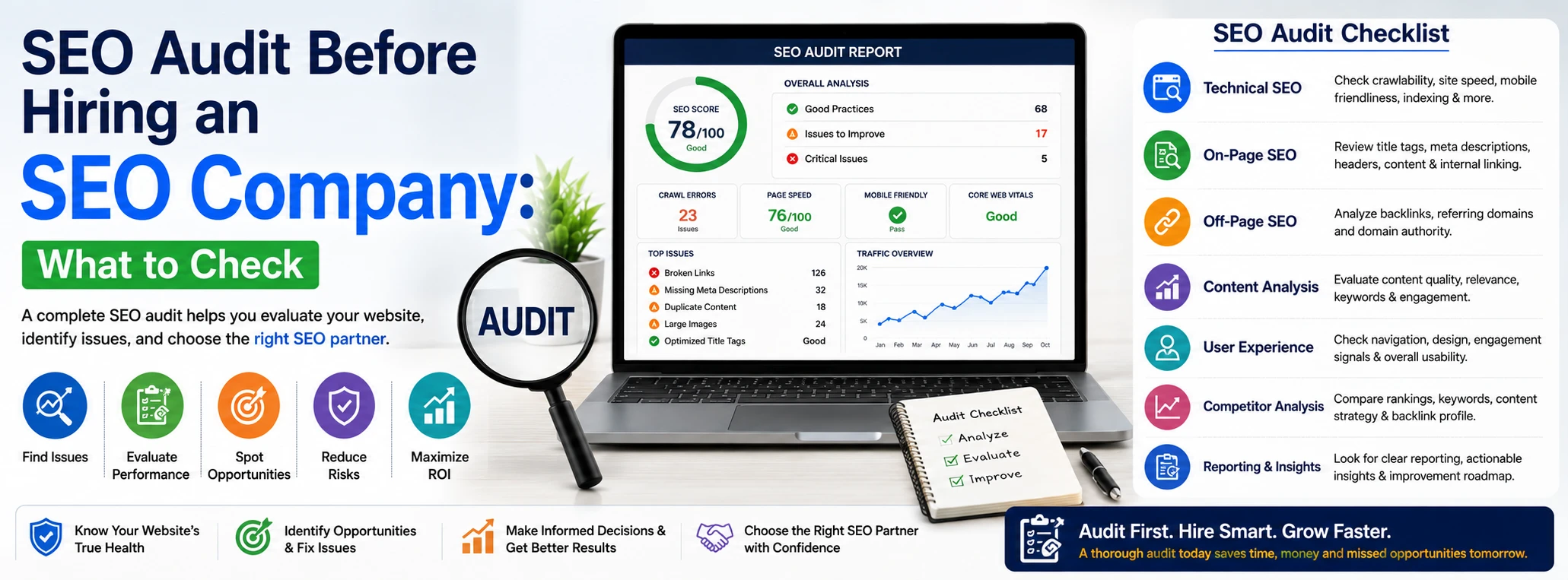
SEO Audit Before Hiring an SEO Company: What to Check
Should you get an SEO audit before hiring an SEO company? Yes. An SEO audit can help you understand your website’s current search performance, identify technical and content problems, uncover growth opportunities, and determine what type of SEO work your business actually needs.
Before signing an SEO contract, it is important to know what an agency plans to improve and why. A professional SEO audit provides a starting point for evaluating your website and comparing SEO recommendations from different providers.
If you are still researching SEO providers, start with our guide on how to choose an SEO company. You can also learn how to evaluate an SEO company before making your final decision.
Table of Contents
- What Is an SEO Audit?
- Why Get an SEO Audit Before Hiring an Agency?
- What Should an SEO Audit Check?
- 1. Technical SEO
- 2. Indexing and Crawlability
- 3. Website Structure and Navigation
- 4. On-Page SEO
- 5. Keyword Targeting
- 6. Content Quality
- 7. Internal Linking
- 8. Backlink Profile
- 9. Competitor SEO Analysis
- 10. Local SEO
- 11. Mobile SEO and Page Experience
- 12. Analytics and Conversion Tracking
- 13. Trust and Expertise Signals
- 14. SEO, AEO and GEO Readiness
- What Should an SEO Audit Report Include?
- SEO Audit Red Flags
- Questions to Ask About an SEO Audit
- SEO Audit FAQs
What Is an SEO Audit?
An SEO audit is a detailed evaluation of a website’s search engine optimization performance. It examines technical SEO, website structure, content, keywords, backlinks, internal linking, user experience, search visibility, and other factors that can influence organic search performance.
The purpose of an SEO audit is not simply to create a long list of problems. A useful audit should identify the most important issues, explain why they matter, and prioritize the actions that can create meaningful improvements.
Depending on the website, an SEO audit may include technical analysis, content analysis, keyword research, competitor analysis, backlink analysis, local SEO checks, and conversion tracking.
Why Get an SEO Audit Before Hiring an Agency?
An SEO audit before hiring an agency can help you make a more informed decision about your SEO investment.
It can help you:
- Understand your website’s current SEO condition
- Identify technical SEO problems
- Find content gaps
- Discover keyword opportunities
- Understand your competitors
- Evaluate your backlink profile
- Identify local SEO opportunities
- Improve conversion tracking
- Prioritize SEO tasks
- Compare agency recommendations
An audit can also help prevent businesses from paying for services they do not actually need.
What Should an SEO Audit Check?
A comprehensive SEO audit should look at the entire search ecosystem of a website rather than focusing on one or two ranking factors.
At a minimum, review:
- Technical SEO
- Indexing and crawlability
- Website architecture
- On-page optimization
- Keyword targeting
- Content quality
- Internal linking
- Backlinks
- Competitor performance
- Local SEO
- Mobile experience
- Analytics and conversion tracking
- Trust and expertise signals
- Search and answer-engine visibility
1. Technical SEO
Technical SEO focuses on the technical foundation that allows search engines to crawl, understand, and index your website.
An SEO audit should check for issues such as:
- Broken pages
- Redirect problems
- Duplicate URLs
- Canonical issues
- XML sitemap problems
- Robots.txt configuration
- HTTPS implementation
- Page performance
- Mobile usability
- Structured data
Technical problems can prevent otherwise valuable pages from being properly discovered, crawled, indexed, or understood.
2. Indexing and Crawlability
Search engines need to be able to discover and crawl the pages that you want appearing in search results.
An SEO audit should investigate:
- Which pages are indexed
- Which important pages are not indexed
- Blocked resources
- Unnecessary indexed pages
- Crawl errors
- Orphan pages
- Duplicate content
- Canonicalization
Not every page on a website needs to be indexed. The goal is to make sure important, useful pages are accessible to search engines while unnecessary or duplicate pages are properly managed.
3. Website Structure and Navigation
A clear website structure helps users and search engines understand how your pages relate to each other.
Review:
- Main navigation
- Category structure
- Service pages
- Location pages
- Blog categories
- URL structure
- Breadcrumbs
- Internal linking pathways
Your most important commercial pages should not be buried deep within the website. A well-organized architecture can also support topical authority by connecting related content logically.
4. On-Page SEO
On-page SEO examines how individual pages are optimized for their target topics and search intent.
An audit may review:
- Title tags
- Meta descriptions
- H1 headings
- H2 and H3 structure
- Page content
- Image alt text
- URLs
- Internal links
- Search intent alignment
- Content relevance
Good on-page SEO is not about inserting the same keyword repeatedly. It is about clearly communicating the topic and satisfying the user’s search intent.
5. Keyword Targeting
Keyword research should identify the terms and topics that your target customers actually use when searching for your products, services, solutions, or information.
An SEO audit should examine whether your website is targeting:
- Relevant primary keywords
- Secondary keywords
- Long-tail searches
- Commercial keywords
- Transactional keywords
- Informational queries
- Local search terms
- Question-based searches
The audit should also identify keyword cannibalization, where multiple pages unintentionally compete for the same search intent.
6. Content Quality
Content should provide useful information that satisfies the searcher’s intent and demonstrates genuine knowledge of the subject.
A content audit can identify:
- Thin content
- Outdated content
- Duplicate content
- Content gaps
- Missing commercial pages
- Weak topic coverage
- Underperforming articles
- Pages with strong traffic but poor conversions
A strong content strategy should connect individual articles into logical topic clusters rather than producing unrelated blog posts.
7. Internal Linking
Internal links help users navigate your website and help search engines understand the relationships between pages.
An SEO audit should look for:
- Orphan pages
- Important pages with few internal links
- Relevant contextual linking opportunities
- Broken internal links
- Over-optimized anchor text
- Weak pillar-to-cluster connections
For example, a pillar page about choosing an SEO company can naturally link to supporting articles about SEO audits, SEO pricing, agency services, questions to ask, and SEO performance measurement.
8. Backlink Profile
Backlinks are links from other websites to your website. An SEO audit can help identify the quality, relevance, and overall profile of those links.
Review:
- Relevant referring domains
- Authority of linking websites
- Potentially harmful or suspicious patterns
- Competitor backlink opportunities
- Unlinked brand mentions
- Link-building gaps
Quality and relevance are generally more meaningful than simply counting the number of backlinks.
9. Competitor SEO Analysis
An SEO audit should not look only at your website. Competitor analysis can reveal why competing websites are outperforming you and where opportunities may exist.
Competitor research can examine:
- Top-performing pages
- Target keywords
- Content topics
- Backlink opportunities
- Website structure
- Local search visibility
- Commercial landing pages
- Content gaps
The goal is not to copy competitors. Instead, competitor analysis should identify opportunities to create something more useful, relevant, authoritative, or differentiated.
10. Local SEO
If your business serves customers in specific locations, local SEO should be part of the audit.
A local SEO audit may review:
- Google Business Profile
- Business name, address, and phone consistency
- Local landing pages
- Local keywords
- Customer reviews
- Local citations
- Location-specific content
- Local competitors
Local SEO requirements can differ significantly from national SEO, so the audit should reflect your actual service area and customer behavior.
11. Mobile SEO and Page Experience
Most businesses need to provide a strong experience for users accessing their websites on mobile devices.
An audit should check:
- Responsive design
- Mobile navigation
- Readable text
- Button usability
- Page loading performance
- Intrusive elements
- Overall usability
A technically optimized page is not enough if users struggle to navigate or use it.
12. Analytics and Conversion Tracking
SEO performance cannot be evaluated properly if important conversions are not being tracked.
Before starting an SEO campaign, verify that your website can measure valuable actions such as:
- Form submissions
- Phone calls
- Bookings
- Purchases
- Demo requests
- Quote requests
- Account registrations
Proper tracking allows you to connect organic search visibility with real business outcomes.
13. Trust and Expertise Signals
Search visibility depends on more than keywords and technical optimization. Businesses should also demonstrate credibility and expertise through their website and content.
An SEO audit can review:
- Author information
- Company information
- About page
- Contact information
- Relevant credentials
- Original insights
- Customer reviews
- Case studies
- Clear service information
These elements can help users and search systems better understand who is behind the content and why the business should be trusted.
14. SEO, AEO and GEO Readiness
Search is increasingly expanding beyond traditional search result pages. Businesses should also consider how their content can be understood and surfaced in answer engines and generative search experiences.
An SEO audit can therefore review whether important pages:
- Answer common customer questions clearly
- Use descriptive headings
- Provide concise answers to important queries
- Cover topics comprehensively
- Demonstrate genuine expertise
- Maintain consistent business information
- Use structured content where appropriate
- Build strong topical relationships through internal linking
AEO, or Answer Engine Optimization, focuses on creating content that clearly answers questions. GEO, or Generative Engine Optimization, focuses more broadly on making information understandable, useful, authoritative, and discoverable within generative search experiences.
These approaches should complement, rather than replace, strong foundational SEO.
What Should an SEO Audit Report Include?
A professional SEO audit report should be understandable and actionable. A long list of technical errors is not enough.
A useful SEO audit report should include:
- Executive summary
- Current SEO performance
- Technical SEO findings
- Content findings
- Keyword opportunities
- Competitor analysis
- Backlink analysis
- Local SEO findings where relevant
- Conversion tracking review
- Priority recommendations
- Suggested implementation roadmap
Each major issue should ideally include an explanation of its potential impact and a recommended next step.
How to Prioritize SEO Audit Findings
Not every SEO issue deserves immediate attention. A professional SEO strategy should prioritize tasks based on potential impact, urgency, implementation difficulty, and business value.
A simple prioritization framework is:
- Critical issues: Problems preventing important pages from being crawled, indexed, or accessed.
- High-impact opportunities: Issues that could significantly improve visibility, traffic, leads, or conversions.
- Medium-priority improvements: Optimization opportunities that can strengthen overall performance.
- Long-term improvements: Strategic content, authority, and optimization initiatives.
This approach prevents businesses from spending time and money fixing minor issues while larger opportunities remain unresolved.
SEO Audit Red Flags
Not every SEO audit is created equally. Be cautious if an SEO provider:
- Provides a generic automated audit without business context
- Promises guaranteed rankings based on the audit
- Focuses only on keyword density
- Recommends hundreds of backlinks without explaining relevance
- Cannot explain why an issue matters
- Uses technical jargon without clear recommendations
- Provides no prioritization
- Ignores conversion tracking
- Does not review competitors
- Does not connect recommendations to business goals
A good audit should help you make decisions rather than simply make the website look complicated.
Questions to Ask an SEO Company About Its Audit
Before hiring an SEO company, ask:
- What does your SEO audit include?
- Will you review technical SEO?
- Will you analyze my competitors?
- Will you review my content and keyword targeting?
- Will you check my backlink profile?
- Will you review local SEO if applicable?
- Will you evaluate conversion tracking?
- How do you prioritize SEO issues?
- Will you provide an implementation roadmap?
- Who will perform the audit?
- Will I receive a detailed report?
- What happens after the audit?
For additional questions to ask before signing an SEO agreement, read our guide on questions to ask an SEO company before hiring.
Should You Get an SEO Audit From Every Agency?
You do not necessarily need a full audit from every SEO agency you speak with. Instead, compare how each provider approaches your website, identifies opportunities, prioritizes problems, and connects recommendations to your business goals.
If several agencies provide audits, look for differences in their analysis and recommendations rather than choosing the provider with the longest report.
The quality of the reasoning is more important than the number of pages in the audit.
How Much Does an SEO Audit Cost?
The cost of an SEO audit depends on the size and complexity of the website, the depth of analysis, the number of areas reviewed, and whether the audit includes strategic recommendations and implementation planning.
A basic automated audit may identify common technical issues, while a comprehensive professional audit can involve detailed technical analysis, competitor research, content evaluation, keyword research, backlink analysis, and strategic planning.
For broader information about SEO pricing, read our guide on how much SEO costs.
Can an SEO Audit Guarantee Better Rankings?
No. An SEO audit can identify problems and opportunities, but it cannot guarantee specific search rankings.
Search performance depends on many factors, including competition, website quality, content, authority, search intent, implementation, and changes in search algorithms and user behavior.
A trustworthy SEO company should provide realistic recommendations rather than guaranteeing a specific Google position.
Why Choose eBizInfoSys for SEO Services?
Choosing the right SEO company can directly influence your website’s organic visibility, qualified traffic, lead generation, and digital growth.
At eBizInfoSys, we create customized SEO strategies based on business objectives, target customers, industry competition, website performance, and search opportunities.
With 17+ years of experience, our approach focuses on:
- Customized SEO Strategies:
SEO plans designed around your business goals instead of generic packages. - Technical SEO Expertise:
Improving crawlability, indexing, website performance, technical health, and search accessibility. - Content Optimization:
Developing content strategies based on search intent, topical relevance, expertise, and user experience. - Transparent Reporting:
Clear reporting focused on completed work, performance insights, opportunities, and next steps. - Ethical SEO Practices:
Sustainable optimization strategies designed for long-term organic growth. - Business Growth Focus:
Connecting SEO activity with qualified traffic, leads, conversions, and broader business objectives.
Explore our SEO services to learn more about how we approach sustainable search visibility and organic growth.
About the Author
Written by Rohit Jarial, an SEO professional specializing in technical SEO, content optimization, keyword research, and organic growth strategies.
Rohit Jarial helps businesses improve online visibility through ethical SEO practices, data-driven optimization, and sustainable digital marketing strategies.
Frequently Asked Questions About SEO Audits
What is an SEO audit?
An SEO audit is a detailed review of a website’s technical SEO, content, keywords, website structure, backlinks, search visibility, user experience, and other factors that can influence organic search performance.
Should I get an SEO audit before hiring an SEO company?
Yes. An SEO audit can help you understand your website’s current condition, identify opportunities, and evaluate whether an agency’s recommendations are relevant to your business.
What should an SEO audit include?
A comprehensive SEO audit can include technical SEO, indexing, site architecture, on-page SEO, keyword targeting, content, internal links, backlinks, competitor analysis, local SEO, mobile experience, analytics, conversion tracking, and search visibility.
How often should a website have an SEO audit?
The frequency depends on the website and how frequently it changes. A major website redesign, migration, change in business strategy, or significant search performance issue may justify a new audit. Ongoing SEO campaigns should also continuously monitor technical and performance issues.
Can I do an SEO audit myself?
Yes. Businesses can perform basic SEO checks themselves. However, larger websites and technically complex SEO issues may require specialist analysis and implementation experience.
How long does an SEO audit take?
The time required depends on website size, technical complexity, number of pages, and depth of analysis. A simple website can require less analysis than a large e-commerce or enterprise website.
What is the difference between an SEO audit and SEO strategy?
An SEO audit identifies the current problems, opportunities, and strengths of a website. An SEO strategy uses those findings to create a prioritized plan for improving organic visibility and achieving business goals.
Does an SEO audit improve rankings by itself?
No. An audit identifies what should be improved. The actual SEO results come from implementing the recommendations and continuously optimizing the website based on performance data.
Final Takeaway
An SEO audit before hiring an SEO company can give you a clearer understanding of your website’s current search performance and help you make a more informed investment decision.
Do not judge an audit by its length or the number of issues it identifies. Look for an analysis that explains the problems, identifies opportunities, prioritizes actions, and connects SEO recommendations to your business goals.
The right SEO audit should not simply tell you what is wrong with your website. It should show you what matters most, what should be fixed first, and how SEO can support sustainable business growth.
If you are ready to improve your organic search performance, contact our SEO team to discuss your website, SEO goals, and growth opportunities.
Before making your final decision, learn how to choose an SEO company, understand how to evaluate an SEO company, and review how to measure SEO agency performance and ROI.