


Organic SEO vs Paid SEO: Which Strategy Is Better for Long-Term Growth?
Quick Answer:
Organic SEO is better for businesses that want sustainable traffic, long-term visibility, stronger brand authority, and lower dependency on paid advertising. Paid SEO (PPC) is ideal for businesses seeking immediate visibility, faster lead generation, and campaign testing.
The best strategy depends on your goals, budget, competition, and growth timeline. Many successful businesses combine both SEO and PPC to maximize short-term results while building long-term ROI.
Every business wants more website visitors, qualified leads, and higher revenue. The real challenge is choosing a digital marketing strategy that delivers measurable results while supporting sustainable business growth.
Two of the most popular approaches are organic SEO services and paid search advertising (PPC).
Both strategies help businesses improve online visibility, but they differ significantly in cost, speed, scalability, and long-term return on investment.
Organic SEO focuses on improving website authority, technical performance, content quality, user experience, and search relevance to achieve higher rankings in unpaid search results.
Paid search advertising places your business at the top of search engine results through paid advertisements, providing immediate visibility for selected keywords.
Understanding the difference between Organic SEO vs Paid SEO helps businesses choose the right marketing strategy based on their objectives, competition, budget, and expected growth timeline.
Many businesses search for terms such as
“SEO vs PPC”,
“Organic SEO vs Paid Search”,
“SEO vs Google Ads”, and
“SEO vs PPC which is better”
before deciding where to invest their digital marketing budget.
In This Guide
- What is Organic SEO?
- What is Paid SEO (PPC)?
- Difference between Organic SEO and Paid SEO
- SEO vs PPC cost comparison
- SEO vs Google Ads
- Which strategy provides better ROI?
- Benefits and limitations of SEO and PPC
- When should businesses hire an organic SEO agency?
Key Takeaways
- Organic SEO builds long-term search visibility without paying for every click.
- Paid SEO (PPC) provides immediate traffic but requires continuous advertising investment.
- SEO creates valuable long-term digital assets through optimized content, technical improvements, and website authority.
- PPC is ideal for product launches, seasonal campaigns, promotions, and quick lead generation.
- Combining SEO and PPC often delivers the best balance of short-term performance and long-term growth.
- Experienced organic SEO experts help businesses improve rankings, qualified traffic, conversions, and overall ROI.
What Is Organic SEO?
Organic SEO is the process of improving a website’s visibility in unpaid search engine results through keyword research, content optimization, technical SEO, internal linking, authority building, and user experience improvements.
The primary objective of organic SEO is to help search engines understand your website while connecting your business with users actively searching for relevant products, services, or information.
Unlike paid advertising, businesses do not pay search engines for every website visitor generated through organic rankings. Instead, they invest in creating valuable content, improving website quality, and building long-term search authority.
A professional organic SEO agency generally focuses on:
- Comprehensive keyword research and search intent analysis
- Technical SEO audits and website optimization
- On-page SEO improvements
- High-quality content creation and optimization
- Strategic internal linking
- Authority and backlink development
- User experience (UX) improvements
- Conversion rate optimization
Example:
A business ranking organically for the keyword “organic SEO agency” can receive highly targeted visitors consistently without paying Google every time someone clicks its website.
Why Businesses Invest in Organic SEO
Organic SEO is considered one of the most sustainable digital marketing investments because every optimized webpage, service page, and blog becomes a long-term business asset. Unlike paid campaigns that stop generating traffic when the advertising budget ends, well-optimized content can continue attracting qualified visitors for months or even years.
Businesses investing in organic SEO services often experience stronger online visibility, increased brand credibility, lower long-term customer acquisition costs, and more consistent lead generation.
Working with experienced organic SEO experts also helps businesses identify profitable keyword opportunities, improve website performance, strengthen technical SEO, and create content that aligns with customer search intent.
As website authority grows, organic rankings can generate compounding results, making SEO one of the most cost-effective digital marketing strategies for businesses focused on sustainable long-term growth.
What Is Paid SEO (PPC)?
Paid SEO, commonly known as Pay-Per-Click (PPC), is a digital marketing strategy where businesses pay search engines to display advertisements for targeted keywords.
In PPC advertising, businesses compete for ad placements through keyword bidding. Advertisers pay whenever a user clicks on their advertisement, making it a traffic acquisition model based on advertising budget and campaign performance.
Common paid advertising platforms include:
- Google Search Ads
- Display Advertising
- Shopping Ads
- Social Media Advertising
Paid advertising is useful for businesses that need immediate visibility, faster enquiries, product promotion, market testing, and quick campaign results.
How Organic SEO Works
Organic SEO works by improving different areas of a website so search engines can better understand its relevance, quality, and value for users.
A successful SEO strategy focuses on improving rankings while attracting the right audience and generating meaningful business outcomes.
The organic SEO process generally includes:
- Identifying keywords customers are searching for
- Understanding search intent behind queries
- Creating helpful and relevant content
- Improving website structure and navigation
- Fixing technical SEO issues
- Building website authority
- Optimizing pages for conversions
How Paid Search Advertising Works
Paid search advertising works through keyword bidding systems where businesses create advertisements and compete for visibility in search engine results.
Advertisers select keywords, create campaigns, define audiences, and pay when users interact with their advertisements.
The main components of a PPC campaign include:
- Keyword selection
- Advertisement creation
- Landing page optimization
- Audience targeting
- Campaign tracking and performance analysis
Organic SEO vs Paid SEO: Main Differences
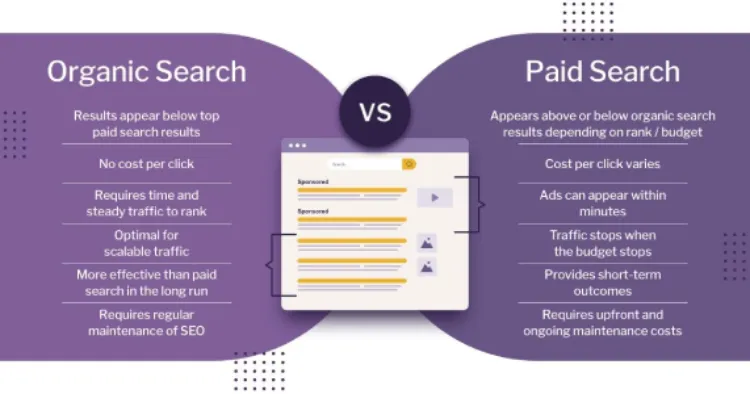
The biggest difference between Organic SEO vs Paid SEO is how businesses generate website traffic. Organic SEO focuses on earning visibility through optimization, valuable content, and authority building, while paid SEO generates traffic through advertising.
| Factor | Organic SEO | Paid Search (PPC) |
|---|---|---|
| Traffic Source | Unpaid search engine results generated through SEO improvements | Paid advertisements displayed on search engines |
| Results Speed | Requires time to build rankings, authority, and consistent visibility | Provides immediate visibility after campaign launch |
| Cost Model | Investment in SEO strategy, content, technical improvements, and optimization | Businesses pay for clicks, impressions, or advertising campaigns |
| Long-Term Value | Can continue generating traffic after rankings improve | Traffic stops when advertising campaigns stop |
| Trust Factor | Organic rankings can improve credibility and brand authority | Users recognize advertisements as paid placements |
| Growth Potential | Grows through content, rankings, backlinks, and website authority | Growth depends on advertising budget and campaign performance |
SEO vs PPC Cost Comparison
Many businesses compare SEO vs PPC cost before deciding where to invest their digital marketing budget. Both strategies require investment, but the cost structure and long-term value are different.
Organic SEO requires investment in keyword research, content creation, technical improvements, internal linking, website optimization, and continuous strategy development.
PPC requires an advertising budget because businesses pay whenever users click their advertisements. The cost depends on keyword competition, targeting, industry, and campaign performance.
| Factor | Organic SEO | Paid Search (PPC) |
|---|---|---|
| Payment Method | Investment in SEO strategy, content, technical improvements, and optimization | Payment based on clicks, impressions, or advertising spend |
| Traffic Duration | Traffic can continue after achieving strong rankings | Traffic stops when advertising campaigns are paused |
| Long-Term Cost | Value can increase as website authority and rankings improve | Requires continuous advertising investment to maintain visibility |
| Scalability | Scales through content, rankings, authority, and organic visibility | Scales based on available advertising budget |
| Customer Intent | Attracts users actively searching for solutions | Targets users through paid campaigns and audience settings |
SEO vs Google Ads: Which Is Better?
Many businesses search for “SEO vs Google Ads which is better” before selecting their marketing approach.
Short Answer:
SEO is generally better for long-term visibility, sustainable traffic, and brand authority, while Google Ads is better for immediate traffic, quick leads, and short-term campaigns.
Choose Organic SEO When You Want:
- Long-term website traffic growth
- Strong online authority and credibility
- Consistent organic leads
- Lower dependency on paid advertising
- Sustainable brand visibility
- Long-term customer acquisition opportunities
Choose Google Ads When You Need:
- Immediate search visibility
- Quick customer enquiries
- Product or service promotion
- Keyword and market testing
- Short-term marketing campaigns
- Faster traffic generation
SEO vs PPC: Which One Should Businesses Choose?
Short Answer:
The right strategy depends on your business goals, budget, competition level, industry, and expected timeline.
Businesses searching for “SEO vs PPC which is better for small business” should understand that both strategies solve different marketing requirements.
Organic SEO Works Best For:
- Businesses building a long-term online presence
- Companies wanting sustainable traffic growth
- Brands focused on trust and authority
- Businesses reducing dependency on advertising
- Companies looking for long-term ROI
PPC Works Best For:
- New product or service launches
- Limited-time offers
- Fast lead generation
- Testing customer response
- Immediate market visibility
Which Provides Better ROI: Organic SEO or Paid SEO?
Short Answer:
Organic SEO often provides stronger long-term ROI because it can continue generating traffic after rankings improve, while PPC requires ongoing investment to maintain visibility and traffic.
However, the best choice depends on your business model, competition, budget, customer journey, and marketing objectives.
Organic SEO can provide better long-term value because:
- Businesses do not pay for every organic visitor.
- High-quality content can continue attracting users over time.
- Website authority improves gradually through consistent optimization.
- Organic rankings can increase brand credibility and trust.
- Customer acquisition costs may reduce as organic visibility grows.
Example:
A business running only PPC campaigns may generate leads while the advertising budget remains active. Once the campaign stops, paid traffic also stops.
A business investing in organic SEO creates digital assets such as optimized service pages, informative blogs, improved website structure, and stronger authority that can continue generating opportunities over time.
Benefits of Organic SEO
1. Long-Term Traffic Growth
One of the biggest advantages of organic SEO is sustainable visibility. A well-optimized page can continue attracting visitors when it provides useful information and matches user search intent.
2. Lower Customer Acquisition Cost
SEO helps businesses reduce dependency on paid traffic by creating long-term search visibility. Although SEO requires investment in strategy and optimization, the cost per visitor can become lower as rankings improve.
3. Higher Brand Trust
Users often consider organic search results more trustworthy because rankings are earned through relevance, content quality, and website authority.
4. Better Quality Leads
Organic visitors often have stronger purchase intent because they are actively searching for solutions, products, or services.
Example:
A user searching for “hire organic SEO consultants” is generally closer to making a business decision compared to a general visitor browsing online.
5. Competitive Advantage
Consistent SEO investment helps businesses build stronger search visibility and compete effectively in their industry.
Benefits of Paid Search Advertising (PPC)
1. Immediate Visibility
Paid campaigns can place businesses in front of potential customers quickly, making PPC useful for urgent marketing goals, promotions, and new launches.
2. Precise Audience Targeting
PPC allows businesses to target audiences based on multiple factors, including:
- Location
- Keywords
- Interests
- Age groups
- Devices
- Search behaviour
3. Easy Campaign Testing
Businesses can quickly test different marketing elements, including:
- Keywords
- Landing pages
- Offers
- Advertising messages
- Audience segments
Limitations of Organic SEO
Although organic SEO provides significant long-term benefits, businesses should understand that SEO requires patience, consistency, and continuous improvement.
- SEO usually takes time to achieve strong rankings and consistent organic traffic.
- Content requires regular updates to match changing search trends and user expectations.
- Competitive industries require stronger SEO strategies and continuous optimization.
- Results depend on website quality, competition level, content relevance, technical performance,
and authority. - Businesses need ongoing monitoring and improvements to maintain search visibility.
Limitations of Paid SEO (PPC)
Paid advertising can generate immediate traffic, but businesses should also understand the limitations of depending only on paid campaigns.
- Advertising costs can increase in competitive industries.
- Traffic stops when advertising campaigns are paused.
- High cost-per-click can reduce overall profitability.
- Businesses require continuous budget allocation to maintain visibility.
- Some users prefer organic search results over advertisements.
SEO vs PPC Which Is Better for Small Business?
Short Answer:
For most small businesses, organic SEO is valuable for long-term growth, while PPC is useful for immediate leads and faster visibility.
Small businesses often search for “SEO vs PPC which is better for small business” because they need to invest their marketing budget strategically.
Organic SEO Is Better For Small Businesses That Want:
- Sustainable website traffic growth
- Better brand credibility and trust
- Long-term customer acquisition
- Reduced dependency on paid advertising
- Consistent online visibility
- Stronger competitive positioning
PPC Is Better For Small Businesses That Need:
- Immediate enquiries
- Quick promotion of products or services
- Fast testing of keywords and offers
- Short-term marketing campaigns
- Faster customer acquisition
When Should You Hire an Organic SEO Agency?
Businesses should consider working with an experienced organic SEO agency when they want to improve search visibility, attract qualified traffic, and build sustainable online growth.
A professional SEO company can help businesses identify ranking opportunities, improve website performance, optimize content, and create a long-term SEO roadmap.
A reliable SEO consultation agency can also provide expert guidance on keyword targeting, technical improvements, content strategy, and conversion-focused optimization.
- Your website is not ranking for important business keywords.
- Competitors are gaining more organic visibility.
- Your website depends heavily on paid advertising.
- Existing content is not generating qualified leads.
- You need professional SEO consultation and strategy planning.
- You want predictable organic growth.
How Organic SEO Experts Improve ROI
Professional organic SEO experts focus on improving business outcomes instead of only increasing keyword rankings. Their goal is to attract qualified visitors, improve conversions, and create sustainable search growth.
A strategic SEO approach generally includes:
- Identifying profitable keyword opportunities based on search intent.
- Improving qualified organic traffic through content and technical optimization.
- Optimizing website pages for better search visibility.
- Improving technical SEO performance and website health.
- Building website authority through quality SEO practices.
- Increasing conversion opportunities from organic traffic.
The objective of SEO is not only achieving higher rankings but also generating better leads, improving online visibility, and supporting long-term business growth.
SEO Growth Approach: How Businesses Improve Organic Visibility
Successful SEO growth requires a combination of technical improvements, relevant content, keyword targeting, internal linking, and continuous optimization.
- Website technical analysis and performance improvements.
- Keyword research based on customer search behaviour.
- Content optimization for improved search visibility.
- Internal linking improvements for better website structure.
- Conversion-focused SEO strategies.
- Continuous monitoring and performance improvement.
Businesses should measure SEO success through meaningful outcomes such as qualified traffic, enquiries, conversions, improved rankings, and stronger online visibility.
Our SEO Experience and Approach
At eBizInfosys, our SEO approach focuses on understanding business objectives, customer search behaviour, website performance, and competitive opportunities.
Our strategies include technical SEO improvements, keyword research, content optimization, internal linking, and user-focused SEO practices designed to improve organic visibility.
We focus on creating SEO strategies that align with search intent and long-term business growth rather than only targeting rankings.
Our team helps businesses build sustainable online visibility through customized SEO solutions, strategic optimization, and data-driven improvements.
How to Choose the Right SEO Consultation Agency?
Choosing the right SEO consultation agency is important for achieving sustainable search visibility, qualified traffic, and long-term business growth.
A reliable SEO partner should focus on transparency, strategic planning, measurable results, and business outcomes instead of only promising rankings.
- Proven SEO Experience: Practical experience in technical SEO, keyword research,
content optimization, and organic growth strategies. - Transparent Reporting: Clear reports covering rankings, organic traffic,
website performance, and SEO progress. - Clear Communication: Regular updates and easy-to-understand SEO explanations.
- Ethical SEO Practices: Use of sustainable SEO methods instead of risky shortcuts.
- Customized SEO Strategies: SEO plans based on business goals, competition,
and target audience. - Focus on Conversions: Priority on qualified traffic, leads, and business growth.
Avoid agencies that promise instant rankings or guaranteed number-one positions because SEO depends on competition, website quality, search algorithms, content relevance, and continuous optimization.
Why Choose eBizInfosys for Organic SEO Services?
eBizInfosys helps businesses improve online visibility through strategic SEO, content optimization, technical improvements, and data-driven search strategies.
Our approach focuses on improving website performance, increasing qualified organic traffic, building search authority, and creating long-term visibility.
- Strategic keyword research and search intent analysis.
- Technical SEO improvements.
- Content optimization strategies.
- Internal linking improvements.
- Organic traffic growth opportunities.
- Conversion-focused SEO solutions.
Our goal is not only to improve rankings but to create sustainable SEO strategies that support measurable business growth.
About The Author
Written by Rohit Jarial, an SEO professional specializing in technical SEO, keyword research, content strategy, and organic growth solutions.
Rohit Jarial helps businesses improve online visibility through ethical SEO practices, data-driven optimization, and sustainable search growth strategies focused on improving rankings, increasing organic traffic, and generating qualified leads.
Frequently Asked Questions
What is the difference between organic SEO and paid SEO?
Organic SEO improves unpaid search rankings through content optimization, technical SEO, internal linking, and authority building. Paid SEO or PPC uses advertisements to generate immediate traffic through paid search placements.
Is organic SEO better than paid SEO?
Organic SEO is generally better for long-term growth because it builds sustainable visibility, website authority, and continuous traffic opportunities. Paid advertising is useful when businesses need immediate results.
How long does organic SEO take compared to PPC?
PPC can generate traffic almost immediately, while organic SEO usually requires several months of consistent optimization to build stronger rankings and reliable traffic.
Is organic SEO cheaper than paid advertising?
Organic SEO requires investment in strategy, content, technical improvements, and optimization. However, businesses do not pay for every organic visitor, creating stronger long-term value.
Can small businesses compete with SEO?
Yes. Small businesses can compete through targeted keywords, helpful content, optimized website experiences, technical improvements, and authority building.
Does SEO provide better ROI than PPC?
SEO can provide stronger long-term ROI because optimized content and rankings can continue generating traffic, while PPC requires continuous advertising investment.
Why hire an organic SEO company?
An experienced organic SEO company provides strategy, keyword research, technical improvements, content planning, and continuous optimization to improve search visibility.
How do I choose the right SEO consultation agency?
Choose an SEO consultation agency that provides transparent reporting, customized strategies, ethical SEO practices, industry understanding, and focuses on qualified traffic and conversions.
Should businesses use SEO and PPC together?
Yes. Combining SEO and PPC creates a balanced marketing strategy where PPC provides immediate visibility while SEO builds long-term traffic, authority, and sustainable growth.
Final Thoughts
The decision between organic SEO vs paid SEO depends on your business goals, budget, competition, and expected timeline.
Paid advertising is effective for immediate visibility and quick testing, while organic SEO helps businesses build sustainable traffic, authority, and long-term customer acquisition opportunities.
For businesses focused on consistent growth, investing in professional organic SEO services
and working with experienced organic SEO experts can create valuable long-term advantages.
A balanced digital marketing strategy often combines SEO and PPC to achieve immediate visibility while building long-term search growth.
Call To Action
Want to know whether organic SEO is the right strategy for your business?
Book a free SEO consultation with our experts and receive a personalized SEO roadmap, keyword analysis, and actionable strategy to improve rankings, organic traffic, and qualified leads.