


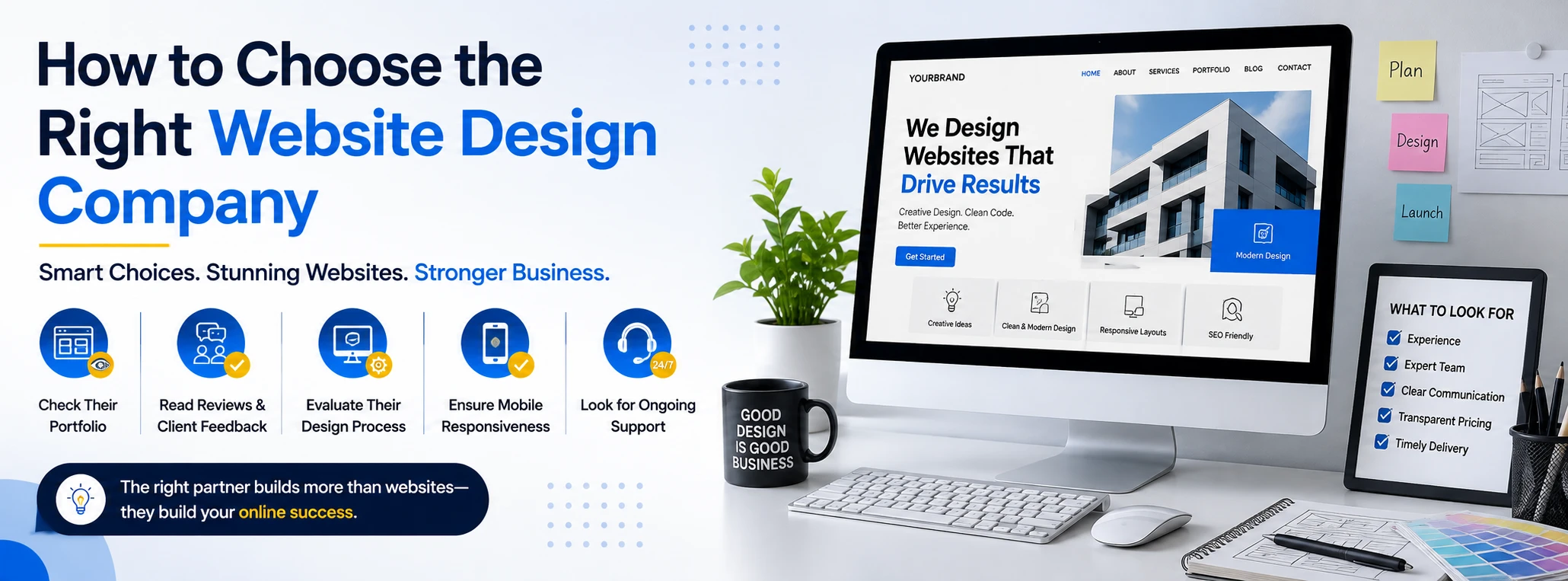
How to Choose the Right Web Design Company: A Complete Guide Before You Hire
Choosing the right web design company is an important decision for any business. Your website is more than an online brochure. It represents your brand, helps potential customers understand your services, and can become one of your most valuable sources of leads and sales.
With so many web design agencies and website design companies offering similar services, it can be difficult to know which one is right for your business.
The right company should understand your business goals, target audience, user experience, website performance, search visibility, and long-term growth—not just how to make a website look attractive.
This guide explains what to look for, what questions to ask, and what factors to consider before hiring a professional web design company.
Quick Answer
What Should You Look for in a Web Design Company?
A good web design company should combine professional design, user experience, website development, SEO, performance, and business strategy.
Before hiring an agency, look for:
- Relevant experience and industry knowledge
- A strong and diverse portfolio
- Custom website design capabilities
- Mobile-first and responsive design
- SEO-friendly website development
- Strong UX and conversion strategy
- Fast and technically sound websites
- Clear project communication
- Transparent pricing and deliverables
- Reliable post-launch website support
The goal is not simply to find a company that can build a website. You want a team that can create a website that supports your business objectives and provides a useful experience for your customers.
1. Start With Your Website Goals
Before contacting a website design company, determine what you want your website to accomplish.
Your website may need to:
- Generate qualified leads
- Increase enquiries
- Promote your services
- Build trust and brand credibility
- Attract local customers
- Sell products online
- Improve an existing website
- Support your digital marketing strategy
Clear goals make it easier to evaluate potential agencies. A professional web design agency should understand these goals before recommending a design, platform, or development approach.
2. Review the Company’s Portfolio
One of the best ways to evaluate a web design agency is to review its previous work. Don’t judge a portfolio only by how visually impressive the websites look. Open the actual websites and consider how well they work across devices.
Look for:
- Clear navigation
- Consistent branding
- Mobile responsiveness
- Logical page structure
- Easy-to-find information
- Clear calls to action
- Strong user experience
- Fast page loading
- Professional content presentation
Whenever possible, review projects that are similar to your industry, business model, or website goals. Relevant experience can help an agency better understand your requirements.
3. Check Whether the Company Understands Your Business
Your website should be designed around your customers and business objectives—not simply around current design trends.
A capable web design company should want to understand:
- Who your customers are
- What problems your business solves
- Which products or services you provide
- Who your competitors are
- What makes your business different
- What action you want website visitors to take
Pay attention to the questions an agency asks during your first conversations. If the discussion immediately focuses on colors, layouts, and technology without first understanding your business, that may be a warning sign.
4. Evaluate Their UX and Conversion Strategy
A professional website should make it easy for visitors to understand your business and decide what to do next.
A strong user experience should answer four basic questions:
- What does this company offer?
- Is this relevant to me?
- Why should I trust this business?
- What should I do next?
A conversion-focused website may use clear service pages, enquiry forms, calls to action, testimonials, case studies,
trust signals, and simple navigation. Good UX/UI design should support the customer’s decision-making process rather than simply trying to make the website visually impressive.
5. Make Sure SEO Is Part of the Website Strategy
SEO should be considered during the website design and development process rather than treated as something to add after launch.
Ask the agency how it handles:
- Website architecture
- Page hierarchy
- Heading structure
- Title tags and meta descriptions
- Internal linking
- Image optimization
- Mobile usability
- Page speed
- URL structure
- Crawlability and indexability
- Structured data where appropriate
An attractive website can still perform poorly in search if its technical foundation, content structure, and internal linking are weak. That’s why SEO-friendly web design should be considered from the beginning.
6. Check Mobile Responsiveness and Website Performance
A modern website needs to work well across phones, tablets, laptops, and desktop screens. Ask how the company approaches responsive web design and website performance.
When reviewing previous websites, check whether:
- Pages load efficiently
- Text is easy to read on smaller screens
- Buttons are easy to tap
- Navigation works smoothly
- Important information is easy to find
- Images and interactive elements are properly optimized
Website performance affects user experience, conversions, and search visibility, so it should be part of the overall web development strategy.
7. Understand Their Website Design and Development Process
A professional web design company should have a clear process for moving a project from an initial idea to a finished website.
A typical process may include:
Discovery → Strategy → Information Architecture → Wireframes → UI Design → Development → Content & SEO Setup → Testing → Launch
Ask the agency:
- Who will manage your project?
- How are design revisions handled?
- Who is responsible for website content?
- How is testing performed?
- What happens before launch?
- What is included in the project scope?
A defined process reduces misunderstandings and helps keep the project within the agreed timeline and scope.
Choosing a web design company is only one part of building a successful website. If you also want to understand how to evaluate the technical side of website development, read our guide to choosing the right website development company to learn what to consider when comparing development expertise, technology, security, scalability, pricing, and ongoing support.
8. Compare the Complete Project Scope, Not Just the Price
Price matters, but the lowest proposal is not necessarily the best value.
When comparing website design companies, check whether the proposal includes:
- Number of website pages
- Custom web design
- Website development
- Content integration
- SEO setup
- Analytics configuration
- Forms and third-party integrations
- Testing
- Performance optimization
- Website training
- Maintenance and support
Instead of asking only, “How much does a website cost?”, Ask, “What exactly is included in the project?”
This makes it easier to compare agencies on actual value rather than simply comparing headline prices.
9. Ask About Website Ownership and Access
Before signing an agreement, clarify who owns the website and its associated digital assets.
Ask about ownership and access to:
- Domain name
- Hosting account
- Website files
- Website content
- Images and design assets
- CMS
- Analytics accounts
- Third-party services
A professional website design agency should explain these terms clearly before development begins.
10. Find Out What Happens After the Website Launches
Website development does not necessarily end when your website goes live. Businesses often need ongoing technical and content support.
This may include:
- Website updates
- Security maintenance
- Backups
- Technical troubleshooting
- New website pages
- Content updates
- Performance improvements
- Ongoing website maintenance
Ask the company what support is available after launch and whether maintenance is included or offered separately.
11. What Questions Should You Ask a Web Design Company?
Before making your final decision, ask potential agencies questions such as:
- Have you worked on websites similar to mine?
- Can you show relevant examples of your work?
- How do you approach SEO during website development?
- How do you optimize websites for mobile devices?
- How do you improve website performance?
- Which platform or CMS do you recommend and why?
- What is included in the quoted price?
- What is the expected project timeline?
- How are revisions handled?
- Who owns the website after launch?
- What type of post-launch support do you provide?
The quality and clarity of the answers can tell you a lot about the company’s expertise, communication, and working process.
12. Watch for These Web Design Company Red Flags
Be cautious if a company:
- Promises guaranteed search rankings
- Provides an unusually low quote without a clear scope
- Cannot show relevant previous work
- Avoids discussing SEO or website performance
- Has unclear contracts or deliverables
- Does not clearly explain website ownership
- Has no defined development process
- Is difficult to communicate with before the project begins
A trustworthy web design company should be comfortable explaining its process, pricing, responsibilities, limitations, and expected outcomes.
How Should a Web Design Company Approach SEO, AEO, and GEO?
Modern website design needs to consider how people discover information across traditional search, direct-answer experiences, and AI-powered search interfaces.
However, the goal should not be to create a website that is filled with keywords or artificial search-engine language.
A stronger approach is to create clear, useful, well-structured information that answers the questions your customers actually ask.
SEO: Search Engine Optimization
SEO-friendly web design combines technical accessibility with useful content and a logical site structure. Important considerations include crawlability, internal links, mobile experience, page speed, headings, URLs, metadata, and relevant structured data.
If you are specifically comparing SEO agencies, our guide to choosing the right SEO company explains how to evaluate an SEO partner based on experience, strategy, technical expertise, reporting, and long-term business goals.
AEO: Answer Engine Optimization
AEO focuses on making important information easy to understand and answer. Question-based headings, concise answers, clear definitions, useful lists, and well-structured content can make information easier for users and search systems to process.
GEO: Generative Engine Optimization
GEO is commonly used to describe efforts aimed at improving visibility within generative AI search experiences. Rather than relying on keyword repetition, the stronger approach is to provide original, trustworthy, context-rich information that clearly explains the business, its services, expertise, and relevant topics.
In practice, strong SEO fundamentals, useful content, clear website structure, and a good user experience form the foundation for visibility across both traditional and AI-powered search experiences.
Web Design Company Selection Checklist
Before making your final decision, evaluate:
- ✓ Relevant industry experience
- ✓ Quality and relevant portfolio
- ✓ Business and audience understanding
- ✓ UX/UI and conversion strategy
- ✓ Responsive web design
- ✓ Website speed and performance
- ✓ SEO-friendly development
- ✓ Clear project process
- ✓ Transparent pricing and scope
- ✓ Website ownership and access
- ✓ Post-launch support
- ✓ Clear communication
Frequently Asked Questions About Choosing a Web Design Company
How do I choose the right web design company?
Look for a web design company with relevant experience, a strong portfolio, a clear development process, SEO knowledge, responsive design capabilities, transparent pricing, and reliable post-launch support. Most importantly, choose a company that understands your business goals and target audience.
What should I look for in a web design company?
Consider the company’s portfolio, industry experience, UX approach, technical capabilities, SEO process, website performance, communication, pricing, ownership terms, and ongoing support.
How much does a web design company charge?
Web design costs vary depending on the number of pages, design requirements, functionality, integrations, content, SEO requirements, and ongoing support. Compare the complete project scope rather than choosing an agency based only on its starting price.
How long does it take to build a business website?
The timeline depends on the size and complexity of the project. A simple business website generally takes less time than a website requiring custom functionality, integrations, e-commerce features, or extensive content.
Should SEO be included in website design?
Yes. Important SEO foundations such as website architecture, mobile responsiveness, page speed, headings, URLs, internal linking, crawlability, and metadata should be considered during website design and development.
Can a web design company help improve website conversions?
Yes. A professional web design company can use UX, page structure, content presentation, calls to action, forms, trust elements, and user journeys to make it easier for visitors to become leads or customers.
What questions should I ask before hiring a website design company?
Ask about relevant experience, previous projects, design and development processes, SEO, performance, technology, pricing, timeline, revisions, website ownership, and post-launch support.
Choose a Web Design Company That Thinks Beyond Design
The right web design company should be more than a team that creates attractive pages. It should understand how design, technology, content, SEO, user experience, and business objectives work together.
Don’t choose an agency based only on its portfolio or the lowest price. Evaluate its experience, process, technical capabilities, communication, SEO approach, website performance, and long-term support.
A well-planned website should represent your brand professionally, provide a smooth experience for visitors, support search visibility, and help your business generate meaningful results.
If you’re comparing potential web design partners, eBizInfoSys is one company you may consider for
professional web design and website development services, particularly if you’re looking for an approach that combines design, development, user experience, SEO-friendly foundations, and long-term digital growth.
Ultimately, take the time to compare companies carefully and choose a web design partner that understands where your business is today and where you want it to go next.