


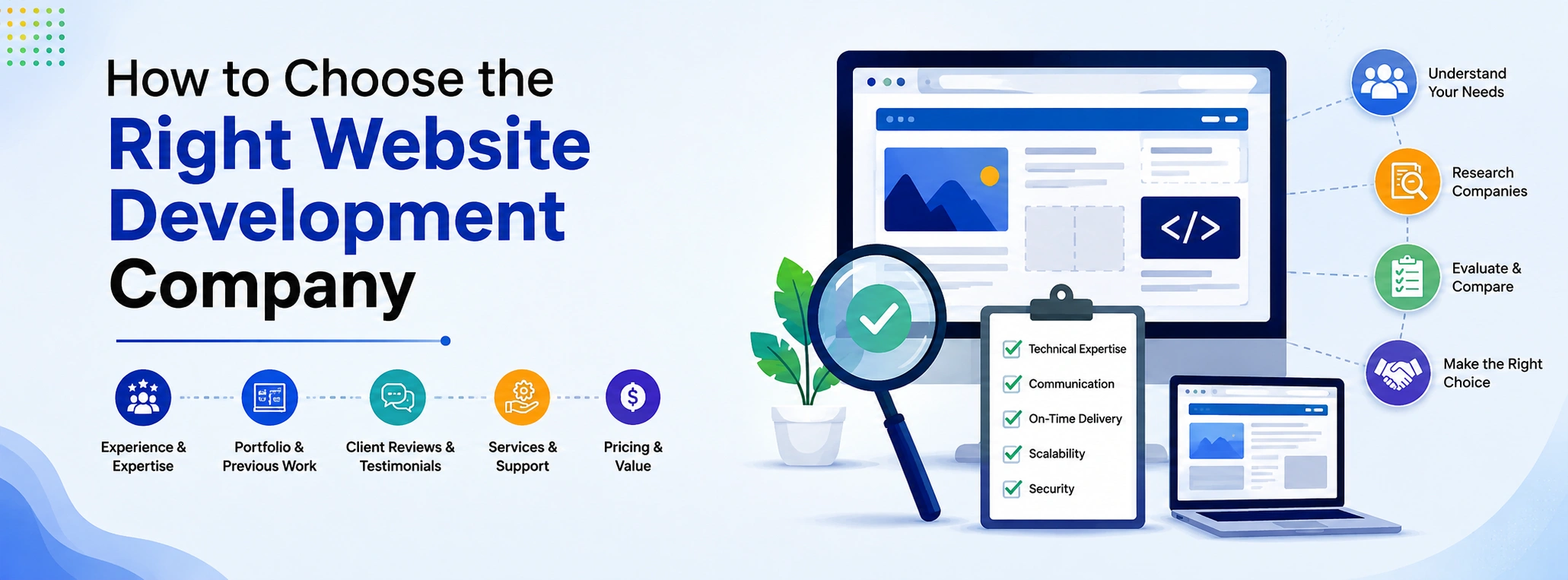
How to Choose the Right Website Development Company
Choosing the right website development company is an important decision for any business. Your website can become one of your most valuable digital assets, helping you attract visitors, generate leads, sell products, build credibility, and communicate with customers.
However, finding the right development partner can be challenging. There are many web development companies and agencies offering different technologies, services, prices, and levels of experience.
The cheapest option is not always the best option, and the company with the biggest portfolio may not necessarily be the right fit for your business. The right choice depends on your requirements, technical needs, business goals, communication, security, scalability, and long-term support.
Quick answer: To choose the right website development company, compare relevant experience, portfolio quality, technical expertise, project scope, pricing transparency, communication, security, ownership, scalability, and post-launch support rather than choosing a company based only on price.
1. Define Your Website Requirements First
Before contacting a web development company, clearly understand what you want your website to accomplish. Clear requirements help you identify companies with the right expertise and make it easier to compare proposals.
Start by asking:
- What is the main purpose of the website?
- Who are my target customers?
- Do I need a business website or an e-commerce website?
- How many pages or sections will I need?
- Do I need online payments or booking functionality?
- Do I need CRM, ERP, API, or other integrations?
- Do I need SEO services?
- Will I need ongoing website maintenance?
- What is my expected launch date?
- What action should visitors take on my website?
For example, a local business may need a professional informational website, while an e-commerce business may require product management, payment gateways, customer accounts, inventory management, shipping integrations, and analytics.
The clearer your requirements are, the easier it becomes to identify the right website development company for your project.
2. Choose a Professional Web Development Company
For many businesses, a website is more than a simple collection of pages. It may support marketing, sales, customer service, payments, lead generation, and day-to-day operations. Choosing an experienced development company can be an important long-term business decision.
Why a Development Team Matters
Modern websites can require UI/UX design, frontend development, backend development, database management, SEO, quality assurance, security, performance optimization, analytics, and ongoing maintenance.
A professional web development company can bring together specialists with different areas of expertise. This can be particularly valuable when a project has multiple technical or business requirements.
Reliability and Continuity
A business website needs support during development and may require updates, troubleshooting, maintenance, and new features after launch. A structured development team can provide continuity as your website evolves.
Support for Future Growth
Your requirements may change as your business grows. You may eventually need new landing pages, integrations, automation, e-commerce functionality, customer portals, or custom web applications.
For businesses looking for a long-term development partner, choose a company whose technical resources and experience match both your current requirements and potential future needs.
3. Evaluate the Website Development Company’s Portfolio
A portfolio is one of the best ways to understand a company’s practical experience. However, don’t judge a development company only by attractive screenshots. Review the actual websites and their functionality.
Check whether:
- The websites are live and accessible.
- They work properly on mobile devices.
- The navigation is clear and easy to use.
- The pages load efficiently.
- The designs look professional and consistent.
- The projects are relevant to your industry or requirements.
- The websites include appropriate custom functionality.
- The company can explain its role in each project.
If you need an e-commerce website, look for relevant e-commerce experience. If you require a custom web application, look for projects involving similar functionality, integrations, or technical requirements.
Relevant experience is often more valuable than simply having a large portfolio.
4. Check Client Reviews and Testimonials
A portfolio shows what a company can build, while client feedback can provide insight into what it is like to work with the company.
Look for feedback about:
- Communication
- Project management
- Meeting deadlines
- Technical knowledge
- Responsiveness
- Problem-solving
- Post-launch support
- Overall project experience
Don’t rely only on testimonials published on a company’s own website. Where possible, check independent review platforms and other reliable sources.
Strong technical skills are important, but communication and project management can have an equally important impact on your overall experience.
5. Ask the Right Questions Before Hiring
Don’t choose a website development company after discussing only the price. A professional project discussion should cover the complete scope, technology, timeline, responsibilities, and support.
Ask questions such as:
- Have you developed websites similar to mine?
- Can you show relevant live projects?
- Who will work on my project?
- What technology or CMS do you recommend?
- Why is that technology suitable for my business?
- What exactly is included in the project?
- What is the estimated development timeline?
- How many revisions are included?
- Is SEO included?
- Is content creation included?
- How will the website be tested?
- What security measures will be implemented?
- What happens after the website launches?
- Do you provide maintenance and technical support?
The quality and clarity of the answers can reveal a company’s professionalism, technical expertise, transparency, and ability to manage your project.
6. Compare Website Development Costs and Proposals
One of the biggest mistakes businesses make is choosing a development company based only on the lowest price.
For example, imagine receiving three proposals:
- Company A: ₹50,000
- Company B: ₹1,00,000
- Company C: ₹1,75,000
Company A is not automatically the best option. The three proposals may have completely different scopes and deliverables.
One proposal may include only a basic website, while another may include custom UI/UX design, development, SEO setup, performance optimization, security, integrations, testing, training, and post-launch support.
When comparing proposals, evaluate:
- Project scope
- Features and functionality
- Design quality
- Technical expertise
- SEO requirements
- Security
- Performance optimization
- Ownership
- Timeline
- Maintenance and support
Compare overall value instead of comparing price alone.
7. Understand Website Ownership Before Signing
Website ownership is an important consideration when hiring website development services.
Ask who will control or have appropriate administrative access to:
- Domain name
- Hosting account
- Website files
- Source code
- Database
- CMS
- Design files
- Google Analytics
- Google Search Console
- Business email
- Third-party services
Your business should have appropriate access to important accounts and assets associated with the website. The exact ownership and access arrangement should be clearly defined in your agreement.
“If we stop working together in the future, can I access and move my website to another provider?”
Ask this before development begins. Clear ownership and access terms help protect both the client and the development company.
8. Check Mobile Responsiveness and Website Performance
A professional business website should provide a good experience across smartphones, tablets, laptops, and desktop computers.
Check:
- Mobile navigation
- Buttons and forms
- Text readability
- Images
- Page layouts
- Checkout process
- Loading speed
Ask your development company how it plans to optimize images, code, caching, hosting, and other performance factors. Good performance can improve user experience and support a strong technical foundation for search visibility.
9. Make SEO Part of Your Website Development Strategy
A beautiful website does not automatically bring visitors from search engines. That’s why SEO should be discussed before development begins.
If you are also evaluating an SEO partner for improving your website’s organic visibility, read our guide to choosing the right SEO company to understand what to look for in an SEO agency, including experience, technical expertise, content strategy, reporting, and long-term SEO practices.
Ask whether the website will have a strong technical SEO foundation, including:
- SEO-friendly URLs
- Page titles
- Meta descriptions
- Proper heading structure
- XML sitemap
- Robots.txt
- Mobile-friendly design
- Fast loading performance
- Internal linking
- Image optimization
- Google Search Console setup
Be cautious with anyone who promises guaranteed #1 Google rankings. Search visibility depends on many factors, and reputable providers should avoid guaranteeing a specific ranking position.
10. Ask About Security, Maintenance, and Support
Website development does not end when your website goes live. Depending on the technology and business requirements, your website may need ongoing maintenance, updates, security improvements, backups, bug fixes, and support.
Ask about:
- SSL/HTTPS
- Software updates
- Regular backups
- Security updates
- Access control
- Malware protection
- Plugin or dependency updates
- Bug fixing
- Performance monitoring
Also ask what support is available after launch:
- Initial post-launch support
- Monthly maintenance
- Technical support
- Feature updates
- Emergency troubleshooting
Understanding these services and costs before development begins can help you plan your long-term website budget and avoid unexpected expenses.
11. Watch for Website Development Company Red Flags
Before hiring a web development company, watch for warning signs that could create problems later.
Extremely Low Quotes
An unusually low price may mean that important features, testing, security, SEO, or support are excluded. Always compare the scope before comparing prices.
No Written Agreement
The agreement should clearly explain project scope, deliverables, payment terms, responsibilities, ownership, timeline, revisions, and support.
No Relevant Portfolio
If a company cannot demonstrate relevant experience, ask detailed questions about how it will handle your specific requirements.
Guaranteed Google Rankings
Be cautious of anyone promising guaranteed search rankings. SEO requires ongoing work and depends on numerous factors.
Unclear Ownership
Make sure you understand who controls your domain, hosting, website, CMS, analytics, and other important business assets.
No Post-Launch Support
Ask who will help when your website needs updates, maintenance, bug fixes, security improvements, or new functionality.
Poor Communication
If communication is difficult before hiring a company, managing the project may become even more difficult after development begins.
12. Choose a Company That Understands Your Business
A professional website development company should not simply ask:
“How many pages do you want?”
It should also understand:
- Who your customers are
- What your business goals are
- What problem your website needs to solve
- What action visitors should take
- Who your competitors are
- How website success will be measured
- Which features are most important
- How the website may need to grow in the future
This approach shows that the development team is thinking about your business objectives rather than simply building a collection of web pages.
Website development is only one part of creating a successful online presence. The design, user experience, navigation, conversion strategy, and overall visual presentation also play an important role.
If you are comparing companies for both the design and development side of your project, read our guide to choosing the right web design company to understand what to evaluate when selecting a web design partner.
13. Why a eBizInfoSys Professional Web Development Company Can Be the Better Choice
For businesses, a website can be an important part of marketing, sales, customer service, and daily operations. Because of this, choosing a reliable development partner should be treated as a long-term business decision.
eBizInfoSys, a professional web development company, can bring together developers, designers, project managers, QA professionals, and other specialists depending on the requirements of the project.
A team-based approach can provide broader technical expertise, structured quality assurance, better project continuity, scalability, and ongoing technical support.
It can also make future improvements easier. As your business grows, your website may need additional pages, integrations, automation, e-commerce functionality, customer portals, or custom applications.
This does not mean every project needs the largest possible development team. Instead, choose a professional development company whose experience, resources, and services match the complexity and long-term goals of your project.
Website Development Company Checklist
Before choosing a website development company, use this checklist:
- ✓ Clear website requirements
- ✓ Relevant industry experience
- ✓ Strong portfolio
- ✓ Good client reviews
- ✓ Detailed project proposal
- ✓ Clear project scope
- ✓ Realistic timeline
- ✓ Transparent pricing
- ✓ Clearly defined payment milestones
- ✓ Mobile responsiveness
- ✓ Website performance optimization
- ✓ Technical SEO requirements
- ✓ Security requirements
- ✓ Website and domain ownership clarity
- ✓ Post-launch support
- ✓ Maintenance options
- ✓ Written agreement
Final Thoughts: How to Choose the Right Website Development Company
Choosing a website development company is not simply about finding the cheapest quote or the company with the most attractive portfolio.
You need a development partner that understands your business, communicates clearly, has relevant technical experience, provides transparent pricing, follows a professional development process, and can support your website after launch.
Before making your final decision, compare qualified companies, review their previous work, ask detailed questions, understand ownership terms, and carefully compare what each proposal includes.
Most importantly, think beyond the initial website launch. Your website should be capable of supporting your business today and adapting to your requirements as your business grows.
The right website development company should provide more than website design and coding. It should provide the expertise, reliability, technical resources, security, scalability, and ongoing support needed to turn your website into a valuable long-term business asset.
The Simple Rule
Don’t choose a website development agency based only on the lowest price. Choose a professional development partner based on experience, quality, technical expertise, transparency, scalability, security, and long-term support.
If you are planning a new business website, e-commerce website, or custom web application, start by defining your requirements and then evaluate potential development partners against the criteria in this guide. Explore Website Development Services
Frequently Asked Questions
1. How do I choose a website development company?
Choose a website development company based on relevant experience, portfolio quality, technical expertise, communication, pricing transparency, security, ownership, scalability, and post-launch support. Compare the complete project scope rather than choosing a company only because it offers the lowest price.
2. Why should I hire a website development company?
A professional website development company can provide access to developers, designers, project managers, QA professionals, and other specialists. This team-based approach can be useful for business websites, e-commerce
platforms, integrations, custom applications, and projects requiring ongoing technical support.
3. What should I look for in a web development company?
Look for relevant experience, a strong portfolio, positive client reviews, transparent pricing, clear communication, technical expertise, security practices, SEO knowledge, ownership clarity, scalability, and reliable post-launch support.
4. What questions should I ask a web development company?
Ask about previous projects, project scope, technology, timeline, pricing, revisions, SEO, security, testing, ownership, maintenance, support, and who will work on your website.
5. How much does website development cost?
Website development costs depend on factors such as design, number of pages, functionality, technology, integrations, e-commerce requirements, SEO, content, security, and ongoing maintenance. Compare the complete scope and value of proposals rather than choosing solely based on price.
6. Is SEO included in website development services?
SEO depends on the company’s service scope. Some website development companies include basic technical SEO, while others offer comprehensive SEO as a separate service. Confirm exactly which SEO services are included before signing an agreement.
7. Who should own my website and domain?
Your business should have appropriate ownership and administrative access to key assets, including the domain, hosting, website, CMS, analytics, and relevant third-party accounts. Ownership and access terms should be
clearly documented in the agreement.
8. What are the red flags when choosing a website development company?
Common red flags include unclear project scope, unusually low quotes without details, no written agreement, lack of relevant portfolio work, guaranteed Google rankings, unclear ownership, poor communication, and no clear maintenance or post-launch support.
9. How many website development companies should I compare?
Comparing around three qualified website development companies can help you understand differences in experience, pricing, services, timelines, and project approach. Focus on finding the best fit rather than collecting
the largest number of quotes.
10. What makes a good website development company?
A good website development company combines technical expertise, relevant experience, clear communication, transparent pricing, reliable project management, security awareness, SEO knowledge, scalability, and dependable
post-launch support.