


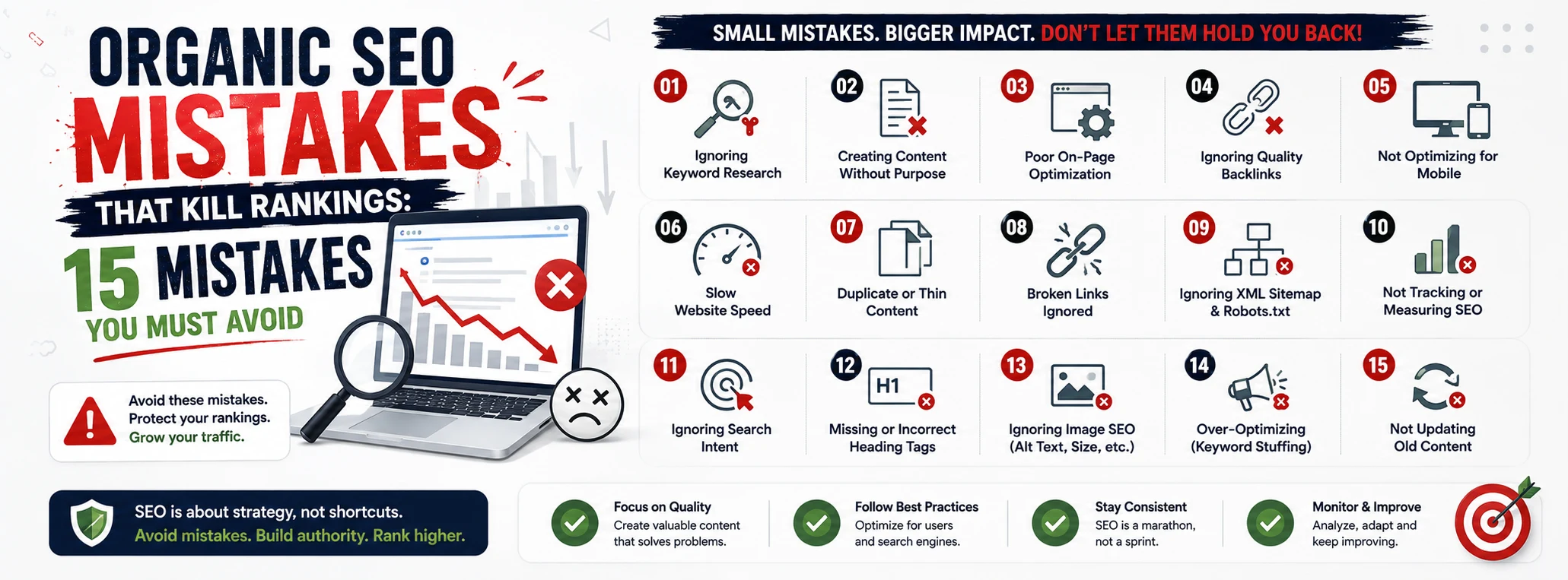
Organic SEO Mistakes That Kill Rankings: 15 Mistakes You Must Avoid
Ranking on Google is becoming more competitive every year. While many businesses focus on creating content and targeting keywords, they often overlook common organic SEO mistakes that quietly damage their search performance.
A website may have excellent products, valuable content, and an attractive design, yet still struggle to generate organic traffic because of hidden SEO errors. These mistakes can reduce visibility, lower rankings, increase bounce rates, and limit potential leads.
The good news is that most SEO problems can be identified and fixed with the right strategy.
In this guide, you’ll discover the 15 most common organic SEO mistakes, why they hurt your rankings, and how organic SEO experts recommend fixing them to achieve sustainable search growth.
Key Takeaways
- Small SEO mistakes can create major ranking problems.
- Technical SEO issues can prevent search engines from properly crawling and indexing pages.
- Keyword stuffing and duplicate content negatively impact website performance.
- Regular SEO audits help identify and fix ranking issues early.
- Following SEO best practices improves visibility, user experience, and conversions.
What Are Organic SEO Mistakes?
Quick Answer
Organic SEO mistakes are errors that reduce a website’s ability to rank in unpaid search engine results. These mistakes can involve poor keyword targeting, technical SEO issues, weak content, broken links, slow website speed, or ignoring user experience.
Fixing these problems helps improve search rankings, increase organic traffic, and generate more qualified leads.
Why SEO Mistakes Matter
Search engines evaluate hundreds of ranking factors when determining which websites appear in search results.
Even if your content is valuable, common SEO problems can prevent search engines from properly crawling, understanding, and ranking your pages.
These mistakes can result in:
- Lower search rankings
- Reduced organic traffic
- Poor user experience
- Lower conversion rates
- Decreased website authority
Regular optimization and SEO audits help protect your website from long-term ranking declines.
15 Organic SEO Mistakes That Hurt Rankings
1. Ignoring Search Intent
One of the biggest SEO mistakes businesses make is targeting keywords without understanding what users actually want.
For example:
A user searching “organic SEO agency” is likely looking for professional SEO services, not a basic explanation of SEO.
How to Fix It
- Understand search intent before creating content.
- Match content with informational, commercial, or transactional searches.
- Answer the user’s main question quickly.
- Create content that solves real problems.
Matching search intent improves user satisfaction and increases ranking opportunities.
2. Keyword Stuffing
Repeating the same keyword excessively does not improve rankings. Modern search engines understand context and prioritize useful content over keyword repetition.
Keyword stuffing can lead to:
- Poor readability
- Reduced user trust
- Lower engagement
- Weak content quality
Better Approach
Use your primary keyword naturally while including related terms, variations, and semantic keywords throughout your content.
Focus on helping users instead of forcing keywords into every paragraph.
3. Publishing Thin Content
Pages with little useful information often struggle to achieve strong rankings.
Thin content usually:
- Does not answer user questions
- Provides limited value
- Creates poor engagement
- Fails to demonstrate expertise
Solution
Create comprehensive content that provides real value, covers topics in depth, and demonstrates experience and knowledge.
High-quality content remains one of the strongest foundations of successful SEO.
4. Duplicate Content
Duplicate content occurs when similar or identical pages appear across a website. This can make it difficult for search engines to determine which page should rank.
Common causes include:
- Multiple URL versions
- Copied blog content
- Repeated service pages
- Incorrect canonical implementation
Solution
- Create unique content for every important page.
- Use canonical tags when necessary.
- Remove unnecessary duplicate pages.
- Maintain a clear website structure.
5. Slow Website Speed
Website speed is an important factor for both user experience and SEO performance.
Slow websites often experience:
- Higher bounce rates
- Lower conversions
- Poor user experience
- Reduced crawl efficiency
Improve Website Speed By:
- Compressing images
- Using browser caching
- Minifying CSS and JavaScript files
- Choosing reliable hosting
- Using a content delivery network (CDN)
A faster website improves usability and creates better ranking opportunities.
15 Organic SEO Mistakes That Hurt Rankings
1. Ignoring Search Intent
Many businesses focus only on keywords but fail to understand what users actually want when they search.
Ignoring search intent is one of the biggest organic SEO mistakes because even well-written content may fail to rank if it does not satisfy user expectations.
For example, someone searching “organic SEO agency” is usually looking for professional SEO services, while someone searching “what is organic SEO” wants educational information.
How to Fix It
- Understand user intent before creating content.
- Create content based on informational, commercial, and transactional searches.
- Answer the user’s main question quickly and clearly.
- Analyze top-ranking pages before publishing content.
2. Keyword Stuffing
Using the same keyword repeatedly does not improve rankings. Search engines have become smarter and can understand topics through related terms and context.
Excessive keyword usage can make content difficult to read and negatively impact user experience.
Better Approach
- Use your primary keyword naturally.
- Add related keywords and semantic terms.
- Focus on solving user problems instead of writing only for search engines.
3. Publishing Thin Content
Thin content provides little value to users and usually struggles to rank in competitive search results.
Common examples of thin content include:
- Short articles without useful information.
- Pages created only to target keywords.
- Duplicate or rewritten content.
- Content that does not answer user questions.
Solution
- Create detailed and valuable content.
- Include practical examples and solutions.
- Demonstrate expertise and industry knowledge.
- Update content regularly.
4. Duplicate Content
Duplicate content can confuse search engines and make it difficult to determine which page should rank.
Common causes include:
- Copied blog content.
- Multiple versions of the same URL.
- Similar service pages targeting identical keywords.
- Incorrect canonical implementation.
How to Fix It
- Create unique content for every important page.
- Use canonical tags correctly.
- Remove unnecessary duplicate pages.
- Improve website structure.
5. Slow Website Speed
Website speed is an important factor for both user experience and SEO performance. Slow websites often lose visitors and experience lower engagement.
Common problems caused by slow websites include:
- Higher bounce rates.
- Lower conversions.
- Poor user experience.
- Reduced search visibility.
Improve Website Speed By:
- Compressing images.
- Using browser caching.
- Optimizing CSS and JavaScript files.
- Choosing reliable hosting.
- Using a Content Delivery Network (CDN).
6. Ignoring Mobile Optimization
Mobile users represent a significant portion of online searches. A website that does not provide a good mobile experience can lose rankings and customers.
Mobile SEO Best Practices
- Use responsive website design.
- Improve mobile loading speed.
- Use readable font sizes.
- Create easy-to-use navigation.
- Ensure buttons are mobile-friendly.
7. Poor Internal Linking
Many websites create excellent content but fail to connect related pages. Internal linking helps search engines understand website structure and distributes authority across important pages.
Benefits of Internal Linking
- Improves website crawlability.
- Helps distribute page authority.
- Increases user engagement.
- Guides visitors to important pages.
- Supports better rankings.
Always add relevant internal links naturally within your content.
8. Missing or Weak Meta Tags
Title tags and meta descriptions influence how users interact with search results. Weak metadata can reduce click-through rates even if your page ranks well.
Every Page Should Have:
- Unique title tag.
- Compelling meta description.
- Primary keyword placement.
- Clear value proposition.
- Accurate page information.
9. Overlooking Technical SEO Issues
Technical SEO problems can prevent search engines from properly crawling and indexing your website.
Common technical SEO issues include:
- Broken links.
- Crawl errors.
- Missing XML sitemap.
- Poor URL structure.
- Incorrect redirects.
- Indexing problems.
- Missing schema markup.
Regular SEO audits help identify and fix these technical problems before they impact rankings.
10. Neglecting Image SEO
Images improve user engagement, but unoptimized images can slow down your website and negatively impact SEO performance.
Large image files increase loading time and may create a poor user experience, especially for mobile visitors.
Image SEO Best Practices
- Compress images before uploading.
- Use descriptive image filenames.
- Add relevant alt text.
- Use modern formats like WebP.
- Avoid uploading unnecessarily large images.
Optimized images improve page speed, accessibility, and overall search performance.
11. Ignoring Content Updates
Publishing content once and never updating it can cause rankings to decline over time. Search engines prefer accurate, fresh, and useful information.
Update older content by:
- Refreshing outdated statistics.
- Adding new examples.
- Improving readability.
- Expanding important sections.
- Updating internal links.
- Adding new FAQs.
Regular content updates are an important part of following SEO best practices.
12. Buying Low-Quality Backlinks
Backlinks can improve authority, but low-quality or spammy backlinks can damage your website reputation.
Avoid:
- Buying cheap backlinks.
- Using link farms.
- Participating in spam directories.
- Automated link-building schemes.
Better Approach
- Create valuable content people want to reference.
- Build relationships with industry websites.
- Use digital PR strategies.
- Earn backlinks naturally.
13. Not Performing Regular SEO Audits
Many businesses ignore regular monitoring until rankings start declining. A professional SEO audit helps identify hidden issues before they become major problems.
An SEO Audit Should Review:
- Technical SEO performance.
- Keyword rankings.
- Backlink profile.
- Content quality.
- Internal linking structure.
- Core Web Vitals.
- Website indexing status.
Regular audits help maintain strong search visibility and identify new growth opportunities.
14. Forgetting About User Experience
Search engines increasingly focus on websites that provide valuable and easy-to-use experiences.
Poor user experience includes:
- Confusing navigation.
- Slow-loading pages.
- Hard-to-read content.
- Intrusive pop-ups.
- Broken buttons or forms.
Improve User Experience By:
- Creating simple navigation.
- Using clear headings.
- Keeping paragraphs short.
- Improving website speed.
- Making pages mobile-friendly.
15. Expecting Instant Results
One of the biggest organic SEO mistakes businesses make is expecting immediate rankings.
SEO is a long-term strategy that requires consistent optimization and patience.
Remember:
- Technical improvements need time to show impact.
- Content needs to be indexed and evaluated.
- Website authority develops gradually.
- Rankings improve through continuous effort.
Signs Your Website Has SEO Problems
Your website may have SEO issues if you notice:
- Declining organic traffic.
- Lower keyword rankings.
- High bounce rates.
- Few indexed pages.
- Slow website performance.
- Poor mobile usability.
- Low click-through rates.
- Reduced leads from search traffic.
Identifying these warning signs early allows businesses to fix problems before they impact long-term growth.
How Organic SEO Experts Fix These Problems
Experienced organic SEO experts follow a structured process to identify and resolve SEO issues.
- Perform a complete website SEO audit.
- Identify technical SEO problems.
- Improve keyword targeting.
- Optimize existing content.
- Strengthen internal linking.
- Improve website performance.
- Build high-quality backlinks.
- Monitor results and adjust strategy.
This systematic approach helps businesses recover rankings and build sustainable organic growth.
Organic SEO Best Practices Checklist
Before publishing or updating any webpage, make sure you complete the following:
- ✅ Target the right keyword.
- ✅ Match search intent.
- ✅ Create original and valuable content.
- ✅ Optimize title tags and meta descriptions.
- ✅ Improve page loading speed.
- ✅ Add relevant internal links.
- ✅ Optimize images.
- ✅ Ensure mobile responsiveness.
- ✅ Fix technical SEO issues.
- ✅ Monitor rankings regularly.
Frequently Asked Questions
What are the most common organic SEO mistakes?
The most common mistakes include keyword stuffing, duplicate content, ignoring search intent, slow website speed, poor internal linking, and technical SEO issues.
How do SEO errors affect rankings?
SEO errors make it difficult for search engines to crawl, understand, and rank your website, which can reduce visibility and organic traffic.
What are technical SEO issues?
Technical SEO issues include crawl errors, broken links, indexing problems, slow loading speed, missing schema markup, and poor mobile usability.
How often should I perform an SEO audit?
A complete SEO audit should generally be performed every three to six months, along with regular monitoring of website performance.
Should I hire organic SEO experts?
If your website rankings are declining or you need a long-term SEO strategy, experienced organic SEO experts can help identify problems, improve visibility, and create sustainable growth.
Final Thoughts
Avoiding common organic SEO mistakes is essential for maintaining strong search rankings and increasing organic traffic. Issues such as technical SEO problems, poor content optimization, weak internal linking, and outdated information can quietly limit your website’s performance.
The good news is that most SEO problems can be fixed with the right approach. By following SEO best practices, conducting regular SEO audits, and continuously improving your website, you can build stronger search visibility and attract more qualified customers.
Successful SEO is not about achieving perfection overnight. It is about identifying problems early, making improvements consistently, and building a website that delivers long-term value.
Ready to Fix Your SEO Issues?
Our team of organic SEO experts provides comprehensive SEO audits, technical optimization, content improvements, and customized SEO strategies designed to improve rankings and increase organic traffic.
Book your free SEO consultation today and discover how we can identify hidden SEO problems, improve website performance, and create a sustainable SEO strategy for long-term success.