


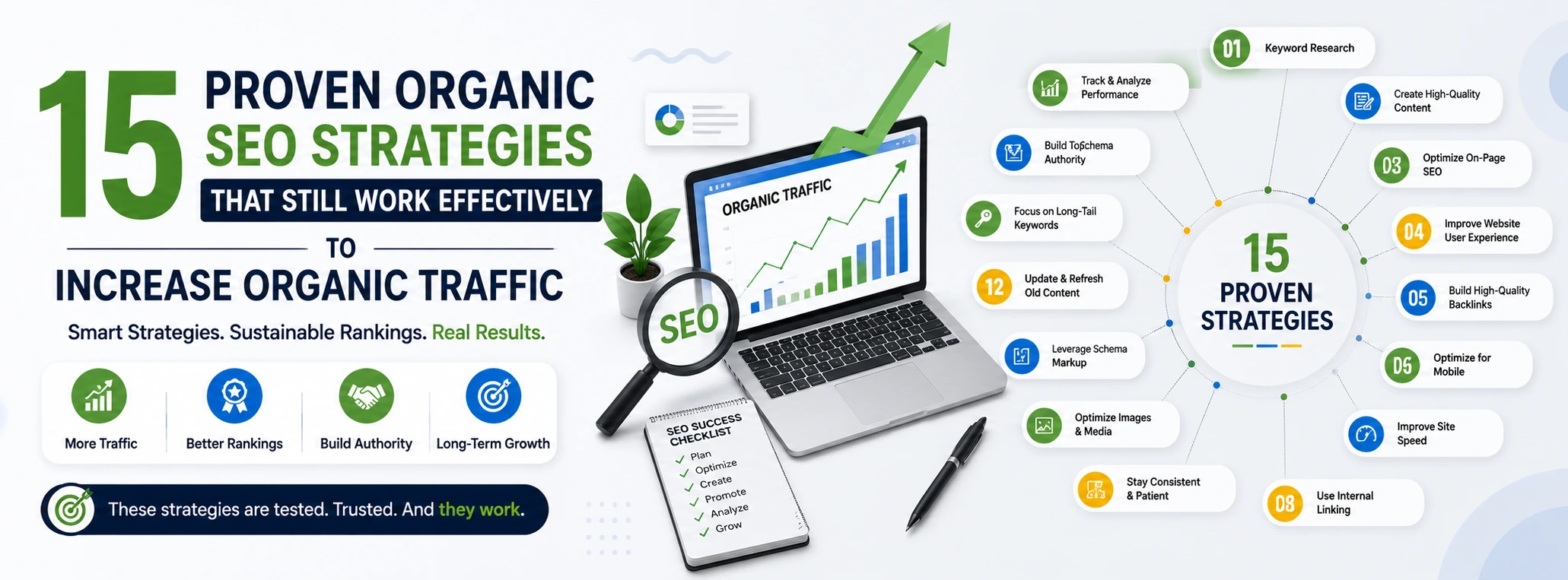
15 Proven Organic SEO Strategies That Still Work Effectively to Increase Organic Traffic
If you’ve been searching for SEO shortcuts or quick ranking tricks, you’re likely to be disappointed. Search engines have become smarter, and sustainable success now depends on following proven organic SEO strategies that prioritize user experience, high-quality content, and technical excellence.
Businesses that consistently invest in ethical SEO practices often achieve higher rankings, increased organic traffic, and better lead generation without relying heavily on paid advertising. Unlike temporary tactics, organic SEO creates long-term value that continues to deliver results over time.
In this guide, you’ll discover 15 proven search engine optimization strategies that continue to work in 2026 and beyond.
Key Takeaways
- Organic SEO focuses on long-term search visibility.
- Quality content remains the most important ranking factor.
- Technical SEO improves crawlability and user experience.
- Search intent matters more than keyword density.
- Consistency is essential for sustainable rankings.
- Combining multiple SEO techniques produces the best results.
What Are Organic SEO Strategies?
Organic SEO strategies are long-term optimization techniques used to improve a website’s rankings in unpaid search engine results.
These strategies include keyword research, technical SEO, content creation, on-page optimization, internal linking, and authority building.
Unlike paid advertising, organic SEO helps businesses generate sustainable traffic without paying for every visitor.
Why Organic SEO Still Matters
Millions of searches happen every day, and most users click on organic search results rather than advertisements.
Businesses investing in organic SEO services benefit from:
- Long-term website traffic
- Better return on investment
- Increased brand authority
- Higher-quality leads
- Greater customer trust
SEO isn’t about tricking search engines—it is about creating the best possible experience for your audience.
Strategy 1: Focus on Search Intent, Not Just Keywords
Many websites fail because they target keywords without understanding what users actually want.
Before creating content, ask:
- Is the user looking for information?
- Are they comparing solutions?
- Are they ready to buy?
- Do they need a local service?
For example, someone searching “organic SEO agency” likely wants to hire an agency, while someone searching “what is organic SEO” wants educational content.
Creating content that matches search intent significantly improves rankings and engagement.
Strategy 2: Perform Comprehensive Keyword Research
Successful SEO starts with identifying the right keywords.
Look for keywords with:
- Strong commercial intent
- Reasonable competition
- Relevant search volume
- Clear user intent
Include a mix of:
- Primary keywords
- Secondary keywords
- Long-tail keywords
- Question-based keywords
Example:
- organic SEO strategies
- organic SEO services
- natural SEO services
- SEO techniques
- SEO best practices
Avoid targeting only high-volume keywords—sometimes lower-volume, high-intent keywords convert better.
Strategy 3: Create High-Quality, Helpful Content
Content remains one of the strongest ranking signals.
Every article should:
- Solve a real problem
- Be easy to read
- Include practical examples
- Answer common questions
- Demonstrate expertise
Avoid publishing thin or duplicate content simply to increase page count.
Instead, create comprehensive resources that users want to bookmark and share.
Strategy 4: Optimize Every Page for On-Page SEO
Even excellent content needs proper optimization.
Every page should include:
- Optimized title tag
- Compelling meta description
- Clear H1 heading
- Descriptive H2 and H3 headings
- Internal links
- Optimized images
- Alt text
- Natural keyword placement
Remember, write for people first and search engines second.
Strategy 5: Improve Website Speed
Page speed affects both rankings and user experience.
A slow website leads to:
- Higher bounce rates
- Lower conversions
- Poor Core Web Vitals
- Reduced search visibility
Improve loading speed by:
- Compressing images
- Enabling browser caching
- Using a CDN
- Minimizing CSS and JavaScript
- Choosing quality hosting
Fast websites create better experiences for both users and search engines.
Strategy 6: Build a Strong Internal Linking Structure
Internal links help search engines understand your website’s structure while guiding visitors to related content.
For example:
- Link your blog about Organic SEO Services to Organic SEO Strategies.
- Connect your Organic SEO Agency page with Organic SEO Consultant articles.
- Link pricing guides to service pages.
Benefits of internal linking include:
- Better page authority distribution
- Easier crawling
- Increased time on site
- Improved user experience
- Higher rankings for important pages
Avoid excessive linking—focus on relevance and user value.
Strategy 7: Strengthen Your Technical SEO Foundation
Technical SEO ensures that search engines can crawl, index, and understand your website efficiently. Even the best content may struggle to rank if your website has technical problems.
A professional technical SEO audit should include:
- Website crawl analysis
- XML sitemap optimization
- Robots.txt review
- HTTPS security
- Canonical tags
- Fixing broken links (404 errors)
- Redirect management (301 redirects)
- Mobile usability improvements
- Core Web Vitals optimization
- Structured data (Schema Markup)
Why Technical SEO Matters
A technically optimized website:
- Improves search engine crawling and indexing
- Enhances user experience
- Reduces website errors
- Supports better search rankings
- Improves website performance
Pro Tip: Perform a technical SEO audit regularly to identify issues before they negatively affect your rankings.
Strategy 8: Optimize Content for EEAT
Google focuses on content quality and evaluates websites based on Experience, Expertise, Authoritativeness, and Trustworthiness (EEAT).
Websites that demonstrate genuine knowledge and credibility have better opportunities to perform well in competitive search results.
Improve EEAT by:
- Publishing content created or reviewed by industry experts.
- Adding detailed author information.
- Showing real business information.
- Including customer reviews and testimonials.
- Supporting claims with trusted sources.
- Keeping content updated and accurate.
Building trust with users helps create stronger long-term SEO performance.
Strategy 9: Build High-Quality Backlinks
Backlinks remain an important ranking factor, but quality matters more than quantity.
A strong backlink strategy focuses on earning links from trusted and relevant websites.
Effective link-building methods include:
- Guest posting on authoritative websites
- Digital PR campaigns
- Publishing original research
- Creating valuable resources and guides
- Industry partnerships
- Local business citations
Avoid:
- Buying backlinks
- Spam link networks
- Low-quality directories
- Automated link-building tools
Low-quality backlinks can damage rankings instead of improving them.
Strategy 10: Keep Your Content Updated
Creating new content is important, but improving existing content can also increase organic performance.
Regularly update older pages by:
- Refreshing outdated information
- Adding new examples
- Improving readability
- Expanding important sections
- Updating internal links
- Adding new FAQs
- Improving images and visuals
Search engines prefer content that remains accurate, useful, and relevant.
Strategy 11: Optimize for Local SEO
Businesses targeting specific locations should include local SEO in their organic search strategy.
Important local SEO techniques include:
- Optimizing Google Business Profile
- Using location-based keywords
- Creating location-specific landing pages
- Building local citations
- Collecting customer reviews
- Maintaining consistent NAP information
Local SEO helps businesses attract nearby customers who are actively searching for their products or services.
Strategy 12: Optimize for AI Search (AEO & GEO)
Search behavior is changing with the growth of AI-powered search experiences. Businesses need content that is easy for both search engines and AI systems to understand.
Improve AI search visibility by:
- Answering user questions clearly.
- Using descriptive H2 and H3 headings.
- Adding FAQ sections.
- Creating concise summary sections.
- Using structured data where appropriate.
- Writing natural conversational content.
- Organizing information with lists and tables.
Well-structured content improves the chances of being understood and surfaced across modern search platforms.
Common Organic SEO Mistakes to Avoid
Even effective SEO strategies can fail because of common mistakes.
Avoid:
- Keyword stuffing
- Duplicate or thin content
- Ignoring search intent
- Poor internal linking
- Slow website performance
- Ignoring mobile optimization
- Publishing without a content plan
- Buying poor-quality backlinks
- Not tracking SEO results
- Failing to update old content
Avoiding these mistakes helps protect rankings and improves long-term SEO success.
Measuring the Success of Your Organic SEO Strategy
SEO success is not only about achieving higher rankings. A successful SEO strategy should improve website visibility, attract qualified visitors, and generate business results.
Important metrics to track include:
| Metric | Why It Matters |
|---|---|
| Organic Traffic | Measures how many visitors come from search engines. |
| Keyword Rankings | Shows progress for targeted search terms. |
| Click-Through Rate (CTR) | Measures how attractive your search listings are. |
| Bounce Rate | Shows whether visitors find your content useful. |
| Conversion Rate | Measures business results from organic traffic. |
| Leads Generated | Tracks qualified customer inquiries. |
| Backlink Growth | Shows improvement in website authority. |
| Core Web Vitals | Measures website performance and user experience. |
Regular monitoring helps identify what is working and where improvements are required.
Strategy 13: Create Topic Clusters Instead of Individual Blogs
Modern SEO focuses on building topical authority instead of publishing random articles.
A topic cluster strategy connects multiple related pages around one main topic.
For example:
Pillar Page
- Organic SEO Services
Supporting Content
- Organic SEO vs Paid SEO
- How to Choose an Organic SEO Agency
- What Does an Organic SEO Consultant Do?
- Organic SEO Pricing Guide
- Organic SEO Mistakes to Avoid
- Organic SEO Strategies
- How Organic SEO Generates Leads
- Why Businesses Choose Organic SEO
Each supporting article should link back to the main pillar page and other related resources.
Benefits of Topic Clusters
- Improves topical authority
- Helps search engines understand website expertise
- Creates stronger internal linking
- Improves user navigation
- Supports higher rankings for competitive keywords
Strategy 14: Improve User Experience (UX)
Search engines increasingly focus on websites that provide a positive experience for users.
A strong user experience includes:
- Fast-loading pages
- Mobile-friendly design
- Clear website navigation
- Readable content formatting
- Helpful visuals
- Simple website structure
- Accessible design
- Clear calls-to-action
Good UX improves engagement, reduces frustration, and increases conversions.
Simple UX Improvements
- Keep paragraphs short and easy to read.
- Use clear headings throughout content.
- Add bullet points where useful.
- Make important buttons easy to find.
- Improve mobile usability.
- Remove unnecessary distractions.
Strategy 15: Track, Analyze, and Improve Continuously
SEO is not a one-time activity. Search algorithms, competitors, and customer behavior continue changing.
Successful businesses regularly review and improve their SEO performance.
Monthly SEO improvements should include:
- Monitoring keyword rankings
- Analyzing organic traffic
- Updating old content
- Fixing technical SEO issues
- Improving internal links
- Analyzing competitor strategies
- Finding new keyword opportunities
Continuous improvement helps maintain rankings and create sustainable growth.
Organic SEO Checklist
Before publishing any website page or blog, make sure you have completed these SEO tasks:
- Targeted the right keyword
- Matched search intent
- Created an optimized meta title and description
- Used only one H1 heading
- Structured content with H2 and H3 headings
- Added relevant internal links
- Optimized images with proper alt text
- Improved page speed and mobile performance
- Included FAQs where useful
- Added a clear call-to-action
Frequently Asked Questions
What are organic SEO strategies?
Organic SEO strategies are techniques used to improve website visibility in unpaid search results. These include keyword research, content optimization, technical SEO, internal linking, and authority building.
Which organic SEO strategy works best?
There is no single strategy that works for every business. The best results come from combining quality content, technical SEO, user-focused optimization, and continuous improvements.
How long does organic SEO take to show results?
Most businesses begin seeing noticeable improvements within 3–6 months. Competitive industries may require more time depending on website authority, competition, and SEO implementation quality.
Are organic SEO services better than paid advertising?
Organic SEO and paid advertising serve different purposes. SEO builds sustainable long-term traffic, while paid campaigns provide faster visibility. Many businesses use both strategies together.
Why is technical SEO important?
Technical SEO helps search engines crawl, understand, and index your website properly. Without technical optimization, even excellent content may struggle to rank.
How often should SEO content be updated?
Important pages should be reviewed every 3–6 months. Updating outdated information, improving content quality, and adding new insights help maintain search performance.
Can small businesses benefit from organic SEO?
Yes. Small businesses can compete effectively by targeting specific keywords, creating valuable content, and optimizing for local search.
Should businesses hire organic SEO experts?
Businesses that lack SEO knowledge or resources can benefit from experienced organic SEO experts who can create strategies, fix technical issues, and improve search visibility.
Final Thoughts
Organic SEO is not about shortcuts or quick ranking tricks. It is about building a strong online presence through valuable content, technical excellence, and user-focused optimization.
The 15 organic SEO strategies covered in this guide provide a complete foundation for sustainable search growth. From keyword research and technical SEO to content strategy, topic clusters, and user experience improvements, each element plays an important role in long-term success.
Businesses that consistently apply these SEO best practices can improve rankings, attract qualified traffic, increase brand authority, and generate more leads.
SEO requires patience, consistency, and continuous improvement. The businesses that invest in long-term optimization are the ones that achieve stronger and more stable results.
Call to Action
Ready to grow your business with proven organic SEO strategies?
Our team of organic SEO experts provides customized SEO strategies, technical website audits, content optimization, and ongoing performance tracking to help businesses improve rankings and generate qualified leads.
Book your free SEO consultation today and discover how our organic SEO services can help you achieve sustainable growth through ethical and effective search engine optimization.